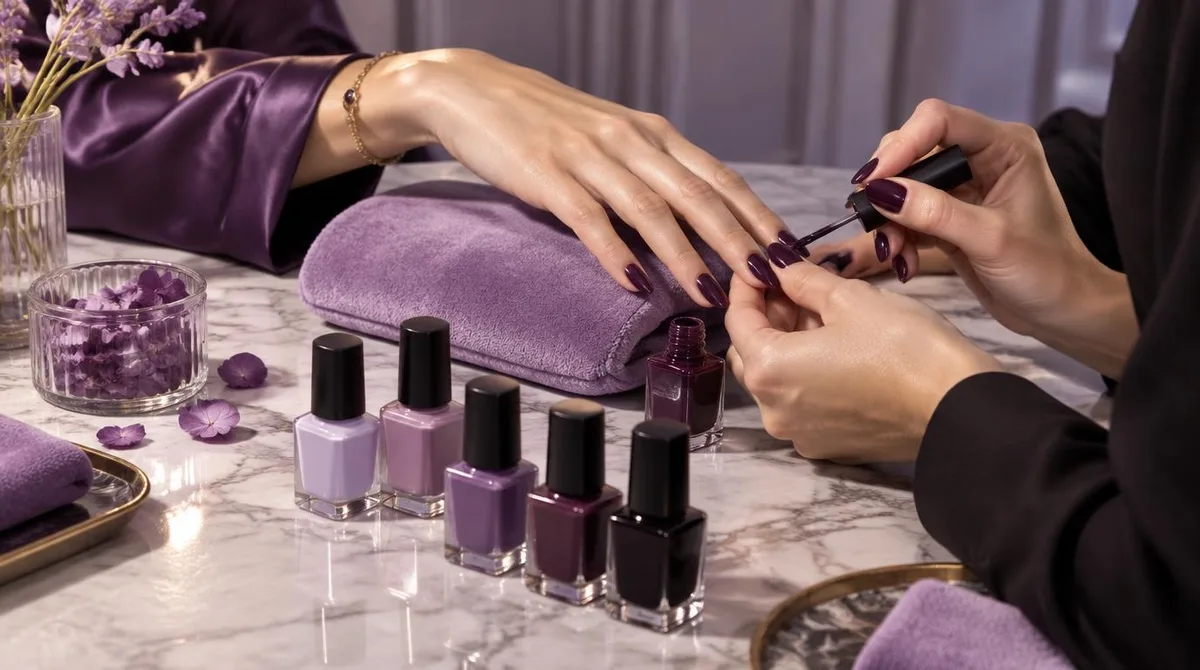
Purple nail designs work because purple itself is a wide family, not a single shade. The color runs from pale lilac to near-black plum, and each stop on the spectrum reads differently on a nail. The short answer: pick your depth first, then your finish, then decide whether the design is a salon job or a two-coat-at-home situation.
It helps to know why the color carries weight. According to Wikipedia, purple has been associated with royalty since antiquity, when Tyrian purple dye made from sea snail secretions was so expensive that only the wealthy could wear it. A manicure in deep violet is borrowing a very old signal. The good news is that your polish costs considerably less than a Mediterranean snail harvest.
This guide walks the shade range, the finishes that suit each one, and the techniques behind the looks. Where a design needs a magnet or a steady hand, we say so. Where it needs only patience and a good top coat, we say that too.
Which purple shade should you pick?
Start with depth, because depth decides everything else. The shade range is genuinely enormous: a reference list of purple shades catalogs everything from thistle and mauve at the pale end to indigo and dark violet at the deep end, with orchid, fuchsia, and plum in between. According to the color reference site Color Meanings, true purple sits at hex #6A0DAD, while fuchsia leans so far toward red it reads almost pink and indigo carries so much blue it borders on navy.
A practical way to choose: pale purples like lilac, mauve, and thistle read soft and romantic, and they flatter shorter nails because they do not shout. Mid-tones like orchid and medium purple are the social butterflies of the family, bright without being neon. Deep purples like aubergine, dark orchid, and indigo do the drama work, and they behave almost like a neutral in cold weather.
One honest note on undertone. Purples with more red, like mulberry or fuchsia, tend to read warmer against the skin. Purples with more blue, like blue violet or indigo, read cooler. If a shade ever looks off in the bottle, check it in daylight before you commit to ten nails.
What are the easiest purple nail designs to do at home?
The honest ranking of difficulty: solid color, then simple accents, then anything involving a brush. A clean two-coat solid in any purple is the most underrated design there is, especially in a deep shade where the color itself does the talking.
One step up is the accent nail. Paint nine nails lilac and one nail deep plum, or reverse it. Because both colors already belong to the same family, the mismatch looks deliberate even when your lines are not perfect. A glitter topper over a solid purple works the same way, adding texture without demanding any skill with a brush.
The French tip is the next rung, and it is friendlier than its reputation. Swap the classic white tip for lavender or orchid on a sheer base, and you get a design that reads current without needing freehand art. The look has history, too; the French manicure has been booking appointments for decades, and a colored tip is its most common modern update. If your tip lines wobble, a small detail brush or even a steady strip of tape as a guide helps, and cleaning up the edges with a brush dipped in remover is not cheating, it is the technique.
Which purple looks need a salon?
Anything requiring chrome, airbrushing, or hand-painted detail earns its salon fee. Chrome finishes over purple are the clearest case: the mirror effect comes from a pigmented powder rubbed over gel polish and sealed, and the timing window between the base and the powder is unforgiving if you have never done it. At home, you will usually get a smudge. In a chair, you get liquid metal.
Ombre and airbrushed gradients are the second category. A smooth fade from pale lilac into deep violet, whether done with a sponge or an airbrush machine, depends on layering thin passes of color, and thin passes are exactly what impatient home painting refuses to do. Hand-painted florals, tiny violets along a French line, or a detailed iris on an accent nail are a third category entirely, and they belong to people who paint nails for a living.
There is also the magnetic option. Cat eye polish uses iron particles in the formula that align under a magnet to create a shifting band of light, and the effect over a deep purple or violet base is one of the prettiest things happening in nails right now. It is technically possible at home, but the magnet timing takes practice. Our analysis: if you want the velvet-lit effect without the learning curve, book it once, watch what the tech does, and then decide whether to invest in the magnet. We covered a connected angle in Cat eye nail designs: how the magnetic polish trick actually works.
What finishes make purple look expensive?
Finish matters as much as shade. A glossy top coat over deep aubergine reads rich, almost lacquered, which suits the color's old association with luxury. A matte top coat over the same shade reads modern and slightly moody, and it is the fastest way to make a cheap polish look considered.
Pale purples do the opposite thing with finish. A milky, sheer lilac, the kind that looks like two thin coats of color over a milky base, reads clean and quiet. Sheer finishes also forgive application sins, which makes them the kind choice for anyone whose polish lines are a work in progress.
Then there is shimmer, and purple wears it unusually well. A fine shimmer in a violet or orchid base catches light the way velvet does, which is fitting given the color's textile history. Keep the rest of the look plain when the polish is shimmery; the shade plus the sparkle is already a complete sentence.
How do you make purple nail designs last?
Longevity is technique, not brand mystique. The moves that matter are unglamorous: thin coats rather than thick ones, a cap of color along the free edge of the nail to seal the tip, and a quality top coat reapplied every couple of days for standard polish. Dark purples show chips more than pale ones do, which is one more argument for the lilac end of the spectrum if you are hard on your hands.
Cuticle care counts too. Oil on the cuticles daily keeps the skin around the polish healthy, and healthy skin is a large part of what makes any manicure look fresh. None of this requires products you cannot find affordably, and a well-stocked local shelf usually carries everything involved.
If you want the cultural context for why nails became a canvas at all, the economics and community behind mani culture explain a lot about how designs like these spread and evolve. Readers following this should also see The Nail Art Economy: Inside The Mani Culture.
The takeaway: purple rewards commitment
Purple nail designs are generous precisely because the color is a spectrum, not a shade. Pale and sheer for quiet weeks, orchid and fuchsia for loud ones, aubergine and indigo for the months when you want your hands to look like they know something you do not. Pick depth first, choose a finish that matches your maintenance appetite, and save the chrome and hand-painted work for the chair. The color spent centuries as the most expensive thing a person could wear. It is currently one of the cheapest ways to look deliberate, and that trade is entirely in your favor.