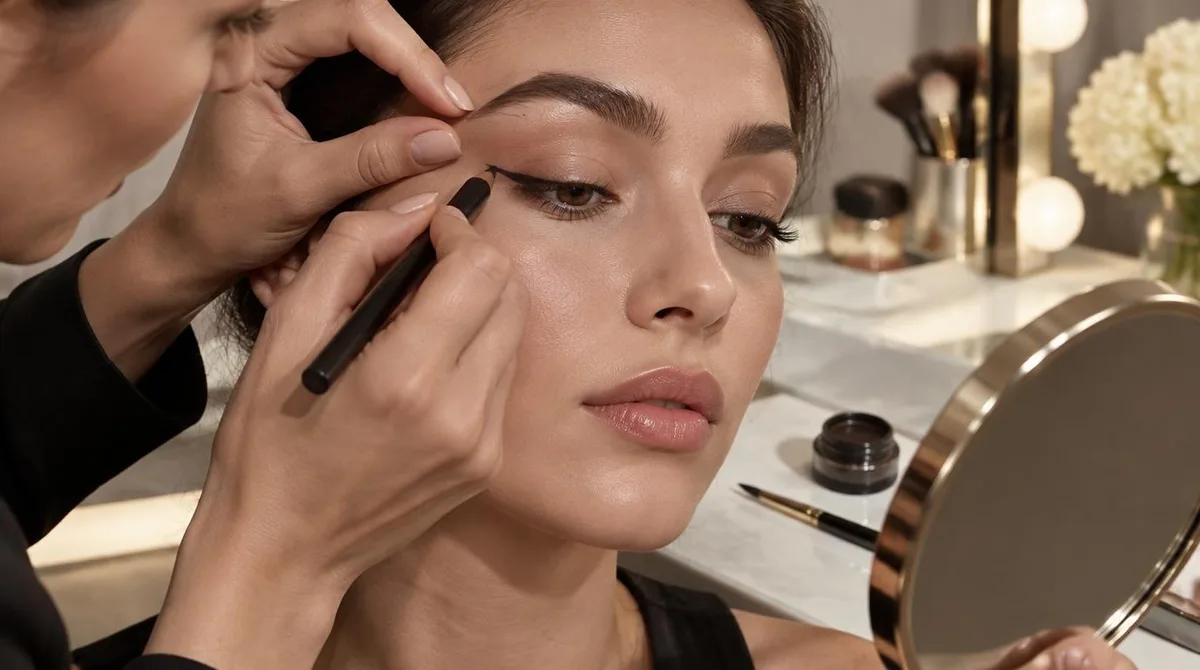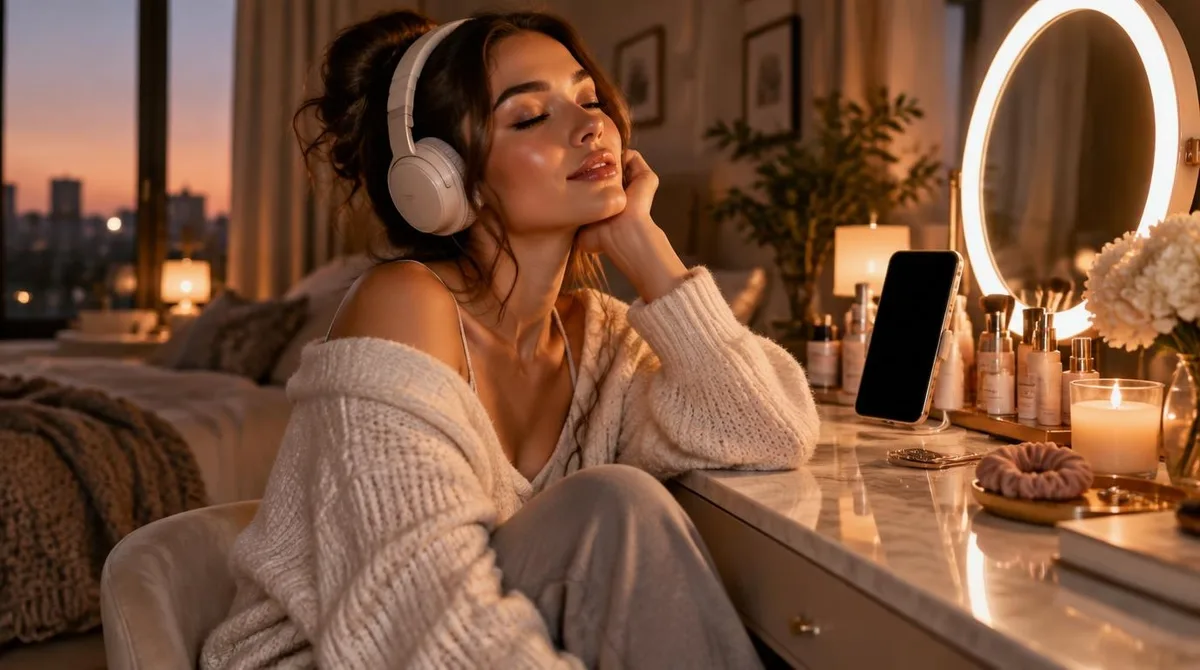
Beauty subliminals are audio tracks — usually layered affirmations buried under rain sounds, lo-fi, or a celebrity voice clip — that claim to change your skin, hair, or face while you listen. The documented part is the trend itself: creators post them across TikTok and YouTube as playlists called things like "clear skin" or "perfect symmetry." The part that isn't documented is the promise. No audio track has been shown to change your face.
What the tracks can plausibly do is narrower and, honestly, more interesting. Affirmations and expectation effects have a long research history in psychology, and repetition-plus-belief is a real recipe for feeling better about how you look. The glow-up happens in the mirror of your mood, not your melanocytes. That distinction — between what a beauty subliminal claims and what it can actually deliver — is the whole story.
Beauty media has been sorting real wellness from vibes for a while now. Vogue's beauty desk regularly runs the wellness-trend gauntlet, from lymphatic drainage drops to decision fatigue, and the pattern in that coverage is consistent: the ritual often helps, the mechanism in the caption usually doesn't. Subliminals fit that shape almost perfectly.
What is a beauty subliminal, exactly?
A beauty subliminal is an audio file built on one idea: that statements played below (or beneath) the level of conscious attention can still reach the mind and change something. The "beauty" versions target appearance — clear skin, longer hair, a slimmer face, "prettier eyes." Creators layer affirmations like "my skin is flawless" under music, nature sounds, or ambient noise, sometimes at low volume, sometimes sped up until the words are a blur. We covered a connected angle in Skin cycling isn't a vibe, it's a math problem for your face.
Some tracks add visual extras: a flickering "desired face" photo, a scrolling script, binaural tones. Others ask you to listen overnight on loop. The formats vary. The claim never does — listen, and your appearance follows.
Does the science back the claims?
Short answer: no, not for the appearance part. The strong version of subliminal messaging — hidden commands rewiring your face — has never held up in mainstream psychology research. Decades of study on subliminal perception have found that faint stimuli can register in the brain, but they don't override biology, and they certainly don't direct collagen. Your skin doesn't have ears.
The weaker, more plausible version is about expectation and mood. Psychologists have studied expectation effects — the way believing a treatment works can change how you feel — for over a century, and the finding is reliable for subjective outcomes. "Subjective" is the key word. Feeling more confident, noticing your good angles, standing taller: those are real, measurable shifts. Shrinking pores from a rain-sounds playlist: not on the evidence.
So when a creator says a track gave her glass skin, the honest read is that something happened — just probably not what the caption says. She may have felt calmer. Calmer people pick at their skin less, sleep differently, and photograph themselves more kindly. The aesthetic outlived the mechanism that supposedly powered it.
Why the trend took off anyway
Subliminals are cheap, private, and endlessly customizable, which makes them ideal internet beauty products. There's nothing to buy, nothing to apply, no before-and-after photo required — just headphones and belief. For younger audiences fluent in manifestation culture, a playlist that promises "prettier hands" slots right next to vision boards and scripting journals.
There's also a comfort angle that deserves credit, not mockery. Listening to a gentle voice tell you that you're beautiful, on loop, at 1 a.m., is a low-stakes act of self-soothing. Compare that to the alternative on offer in beauty culture — a twelve-step routine and a waitlisted lip balm — and the appeal writes itself. The ritual is the point, even when the physics is not.
That's a familiar pattern. We've covered how "beauty sleep" survived as a marketing term with a real backstory, and how skin cycling turned a scheduling idea into a face-math trend. Beauty loves a mechanism story, even a shaky one, because a mechanism makes a vibe feel like a plan. For related coverage, see Beauty Sleep Is A Marketing Term With A Real Backstory.
What actually drives the confidence gains
If the audio isn't rebuilding your face, what is doing the work? A few candidates, none of them secret:
- Repetition shapes attention. Hear "my skin is clear" fifty times and you start scanning for evidence it's true. Confirmation is a powerful editor.
- Ritual reduces anxiety. A fixed listening routine gives structure — and structured routines reliably lower the background hum of appearance worry.
- Expectation changes behavior. People who feel more attractive behave differently: more eye contact, more photos, fewer avoidance habits. The feedback loop is real.
- Community does its own work. Comment sections full of "day 47 and my glow is unreal" supply the social proof no affirmation could.
Notice what's missing: any step that requires the subliminal specifically. A journal, a mirror affirmation, a voice memo you record yourself could plausibly do the same job. The track is packaging. The practice is the product.
Practical steps if you're going to listen anyway
Fine. The headphones are already on. Here's how to keep it honest and safe:
- Treat it as mood care, not skin care. If a track makes you feel calmer, that's a win — bank it as a win for your head, not your face.
- Keep your actual routine. Sunscreen, cleansing, sleep. No playlist replaces them, and skipping them for listening sessions is the one genuinely bad trade here.
- Watch the framing. Tracks built on "fixing" a flaw can quietly sharpen the flaw in your mind. If listening makes you more fixated, that's a reason to stop, not to try another track.
- Skip anything promising medical results. Audio that claims to cure acne, reverse aging, or change bone structure is selling biology it doesn't have. No creator has shown a mechanism for that, and your dermatologist hasn't either.
One more: if appearance anxiety feels heavy rather than playful, a playlist is the wrong tool at the wrong volume. That's a conversation for a professional, not a comment section.
Our analysis: the trend is a mirror, not a mechanism
Beauty subliminals are best understood as beauty culture's most literal product: the belief, sold directly. Every era has one — the tonic, the tape, the track — and each gets marketed with the same sleight of hand, swapping an inner shift for an outer one. The inner shift is real and worth having. The outer one stays where it started: in your routine, your sleep, your genetics, and the light in the bathroom.
So listen if it helps. Label it what it is. And when the next audio trend arrives promising results no speaker can deliver, you'll recognize the shape before the rain sounds even start.