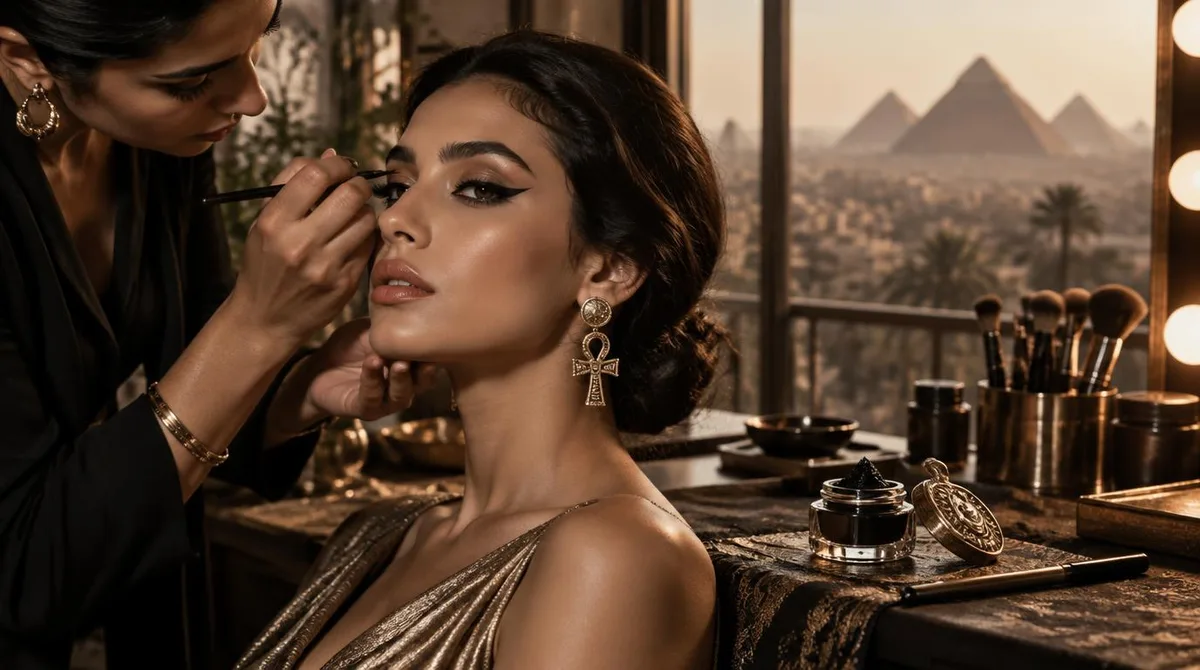
The cat eye has been trending since long before the internet existed. Egyptians and Mesopotamians drew dark lines around their eyes as early as 10,000 BC, per Wikipedia's eyeliner history. The latest reboot, 2022's siren eyes, arrived on TikTok with its name credited to creator Danielle Marcan.
Same wing, new vocabulary. Every era thinks it invented the flick, and every era is wrong in a useful way: the technique outlives the branding. Here is the documented arc, from ground-up minerals to filtered tutorials, with each stop credited by name.
Kohl was the original cat eye
The record starts with kohl — a cosmetic made by crushing stibnite, an antimony mineral. Egyptians of all social classes wore it from the Naqada III era, around 3100 BCE, per Wikipedia's entry on kohl. It doubled as gear: protection against eye ailments, and a shield against harsh sun. Beauty and utility in one dark line.
The story runs deeper than Egypt, too. Isotope analysis of kohl from Nubian cemeteries in Lower Nubia, dated to roughly 2300 to 1500 BCE, shows communities there were using and possibly producing kohl, some of it sourced locally. The wing does not have a single homeland. The kohl record keeps one more plot twist: the English word alcohol descends from the same Arabic root as kohl. Makeup and spirits share an etymology.
The 1960s drew the line thicker
Liquid eyeliner had its graphic moment in the 1960s, when thick black and white lines around the eyes became the makeup fashion tied to designers like Mary Quant, as Wikipedia's eyeliner history documents. The look was drawn, deliberate, and visible from the back row. A cat eye as pop art.
The decades after kept the line alive by changing its costume. Goth and punk fashion pushed eyeliner dark and dramatic through the 1970s, per the same entry. By the early 2000s, the emo scene had a nickname for men in liner — guyliner — popularized in part by members of bands like Fall Out Boy. The encyclopedia's eyeliner entry treats these as one continuous story, and it reads that way.
Siren eyes, the 2022 reboot
In 2022, TikTok renamed the flick again. Siren eyes — an elongated, black-winged look promising allure — took its name from a tutorial by beauty influencer Danielle Marcan, per JSTOR Daily's August 2022 explainer by Aida Amoako. The framing reached back to Greek myth: the sirens, ancient singers of dangerous songs, minus the shipwrecks.
The mechanics stayed honest. Ipsy documented the look as a smudgy cat eye in new packaging, with liner much thicker than a smoky eye and corners extended for length. The technique was decades old. The name was the innovation, and a lot of beauty commentary that summer was essentially footnotes to one tutorial.
JSTOR Daily's piece made the same point with a bibliography: a trend crediting itself to antiquity had a paper trail, and the paper trail led through a 2022 phone screen.
Why the wing keeps winning
The cat eye survives because it is a shape, not a product. Bottles run empty. Geometry does not. Each reboot rebrands the same move — tighter, thicker, longer, lifted — and each generation gets to feel like the first. The 1960s called it mod. The 2020s called it siren. The documented record runs back twelve thousand years, which is a long time for one idea to keep landing. This connects to our earlier piece, The micro-trend lifespan: how long you actually have before it peaks.
Conclusion: the flick outlives the algorithm
Egypt wore kohl as armor. Mod London wore it as graphics. 2022 wore it as a character with a mythology degree. The names change; the line does not. If siren eyes prove anything, it is that the cat eye was never really a trend. It is the baseline the trends keep borrowing — credited, this time, all the way back to the Bronze Age. For related coverage, see The 90s lip liner comeback was never really gone: a lineage.