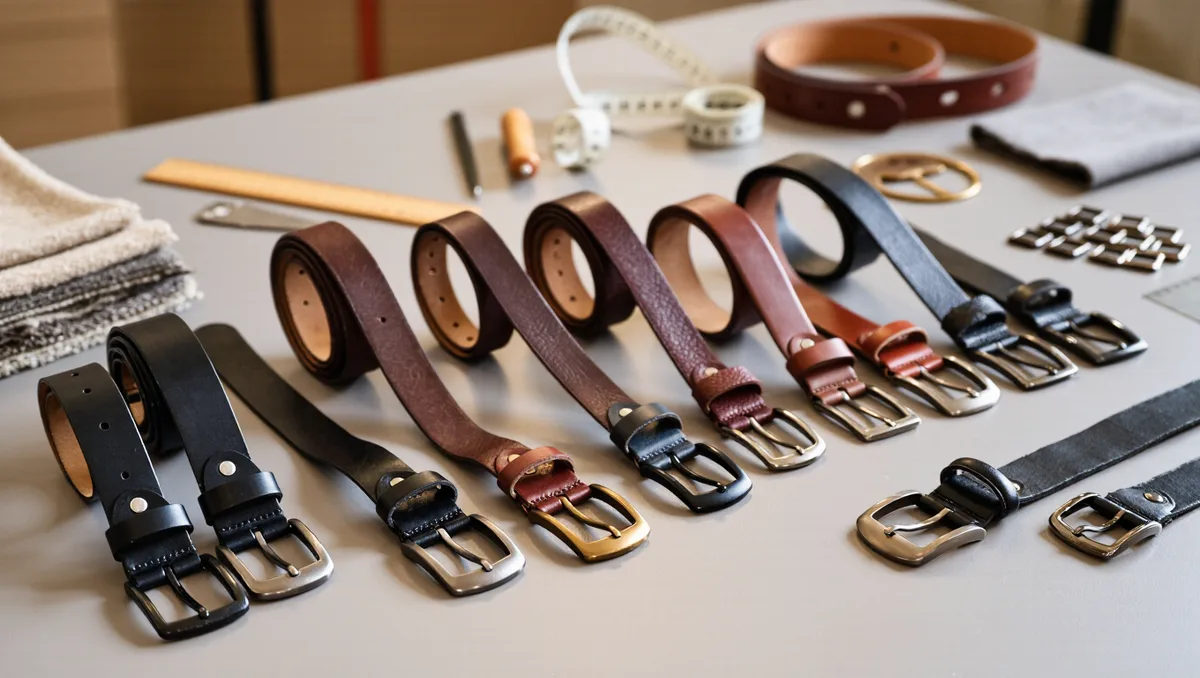
A belt is one of those accessories that looks interchangeable until it isn't. The wide work belt that holds up jeans will swallow a delicate trouser waistband whole. The skinny belt that looked so neat over a dress vanishes completely the second you thread it through belt loops on a coat. The difference between those two outcomes is usually about 15 millimeters, and once you know the logic, you can spot it on the shelf.
Belt width is measured across the strap, and most labels state it directly. Browse the men's belts at Walmart and you'll see the numbers printed right in the product names: a 30mm reversible feather-edge belt, a 35mm stretch belt, a 38mm double-loop casual belt. That range — roughly 30 to 38 millimeters for everyday men's styles — maps almost exactly onto the casual-to-dressy spectrum. Women's belts run wider still in both directions, from barely-there 15mm waist-cinchers to statement waist belts double that.
The short version of the rule: match the belt's visual weight to the garment's. Fine fabric, small loops, and a clean front want a narrow belt. Heavy denim, big loops, and workwear want something wider. Get it backwards and either the belt bullies the outfit or the outfit erases the belt.
Why a wide belt ruins a dressy trouser
Dress trousers are cut with a clean, flat waistband, often with belt loops sized for a slim strap. Thread a 38mm casual belt through them and two things go wrong. First, the strap doesn't sit flat — it bunches and folds at every loop, which reads as a fit problem even when the trousers fit perfectly. Second, the wide leather adds bulk right at the waist, which is exactly where a tailored silhouette can't afford it.
There's also a proportion issue. A dressy trouser usually tapers toward the hem, so the eye reads the outfit top-down as a clean line. A wide belt with a big buckle interrupts that line at the narrowest point of the body. It's the same reason a chunky sneaker can fight a slim suit — the pieces are speaking different dialects.
For tailored pants, a belt in the 25mm to 30mm range is the safe zone. Narrow enough to lie flat, wide enough to actually fill the loops. If the belt slides around inside the loops with room to spare, it's too skinny for that trouser — see the coat problem below.
Why a skinny belt disappears under a coat loop
The opposite failure is quieter but just as real. A 15mm or 20mm belt threaded through the generous loops of an overcoat or a pair of carpenter jeans looks fine standing up — and then you sit down, move, or throw the coat over it, and the strap slips, twists, or simply stops doing its job. Belt loops exist to hold a strap under tension; a strap that's much narrower than the loop has nothing to press against.
It's also a visibility problem. A skinny belt over a dress or a blazer reads as a deliberate styling choice — a line drawn at the waist. The same belt holding up jeans reads as an accident, a thread that wandered into frame. Skinny belts are decoration. Wide belts are infrastructure. Trouble starts when you ask one to do the other's job.
A simple sizing logic for any outfit
You don't need to memorize a chart. You need three questions, asked in order.
- What is the belt for? Holding something up, or drawing a line? Utility wants width and a sturdy buckle. Styling wants whatever looks right over the garment — often narrower, often worn higher.
- How big are the loops? The strap should fill the loop without forcing it. If you can see daylight on both sides of the buckle tongue, size up. If you have to work the strap through, size down.
- How heavy is the fabric? Denim, canvas, and heavy wool can carry a wide strap. Poplin, fine knits, and satin want narrow — a wide belt on delicate fabric creates puckering and bulk that no amount of tucking fixes.
Run any outfit through those three and the answer usually picks itself. Jeans plus work shirt: 35mm to 40mm. Suit or tailored trousers: 25mm to 30mm, matching the shoe leather. Dress worn at the waist: whatever reads as a deliberate line, often 20mm to 35mm depending on the fabric.
What this means for the rest of your wardrobe
Here's the part worth saying out loud: you probably need fewer belts than the drawer suggests, but more than one. A single belt can't serve both the suit and the jeans, and pretending it can is how closets end up full of near-misses. Two or three widths — one narrow for tailoring, one mid-width for everyday, one wide for heavy layers — cover nearly everything a real wardrobe throws at you.
This is the same logic that makes a small, deliberate wardrobe work. If you're editing down to pieces that earn their spot, a belt bought for a specific waistband beats a belt bought on vibes every time — the same thinking behind what a capsule wardrobe actually means. And if a beloved trouser's loops are oddly sized, remember that some fixes are beyond the needle: check what a tailor can and can't fix before you commit to re-looping anything.
Width isn't the only variable — buckle scale, leather finish, and formality all matter too. But width is the one that determines whether the belt physically belongs in the waistband at all, so it's the one to settle first. Get the millimeters right and the rest of the decision gets easy.
The takeaway
Belt width is proportion, not preference. Wide belts for heavy fabrics and big loops; narrow belts for fine ones. The label tells you the number, the loops tell you the truth, and the fabric tells you the rest. Match the strap to the waistband and the belt stops being an afterthought — it becomes the line that holds the whole outfit together.