Fragrance layering — wearing two or more scents together to build a signature that nobody else owns — works because perfumers structure it, not despite structure: the method pairs scents that share notes or sit in complementary families on the fragrance wheel, applies the heavier scent first, and builds from base to top. The practice is centuries old in the Middle East, where layering oud, musk, and rose is a formal part of perfume culture, and it was commercialized for the West largely by Jo Malone London, which has been encouraging customers to combine its scents since the 1990s. What looks like spontaneous spraying is actually taxonomy.
The good news: the taxonomy is learnable in one evening. The better news: once you know it, your collection doubles for free.
What is fragrance layering, exactly?
Layering means wearing multiple fragrances — or a fragrance plus scented body products — so they blend on skin into a combination that is uniquely yours. Done well, one scent supplies the foundation while another adds lift, and the result reads as a single coherent perfume rather than two competing ones. Done badly, it reads as a department-store elevator. The difference is method: shared notes, deliberate order, and restraint.
Most people layer on impulse, which is why most people layer badly. The mechanics below are simple, but they are not optional.
Where does layering come from?
The deepest roots are in the Gulf, where layering is standard practice rather than a technique: bakhoor smoke scents clothing and hair, concentrated oud oils go on the skin, and rose, musk, or amber sprays stack on top — a ritual of hospitality and personal presentation documented across Middle Eastern perfume culture for generations. Western perfumery arrived at layering through retail: Jo Malone London built its brand identity on the idea that its colognes should be combined like a wardrobe, and Michael Edwards' Fragrance Wheel — first published in 1983 — gave consumers a shared map of scent families that made pairing feel logical instead of mystical.
By the 2020s, niche brands were selling pre-designed 'layering duos,' and TikTok turned combination-building into content. The practice got a rebrand from eccentric habit to marketable skill. Its history stayed where it started: in households where one perfume was never the plan.
What is the actual method for layering perfume?
Three rules carry most of the weight. First, pair scents that share at least one note, or pair a simple scent with a complex one — vanilla under anything floral, citrus over most woods. Second, spray the heavier, denser scent first and the lighter one on top, so the bright notes do not get buried. Third, cap the stack at two, maybe three, scents — beyond that, the blend stops being a signature and starts being a spill.
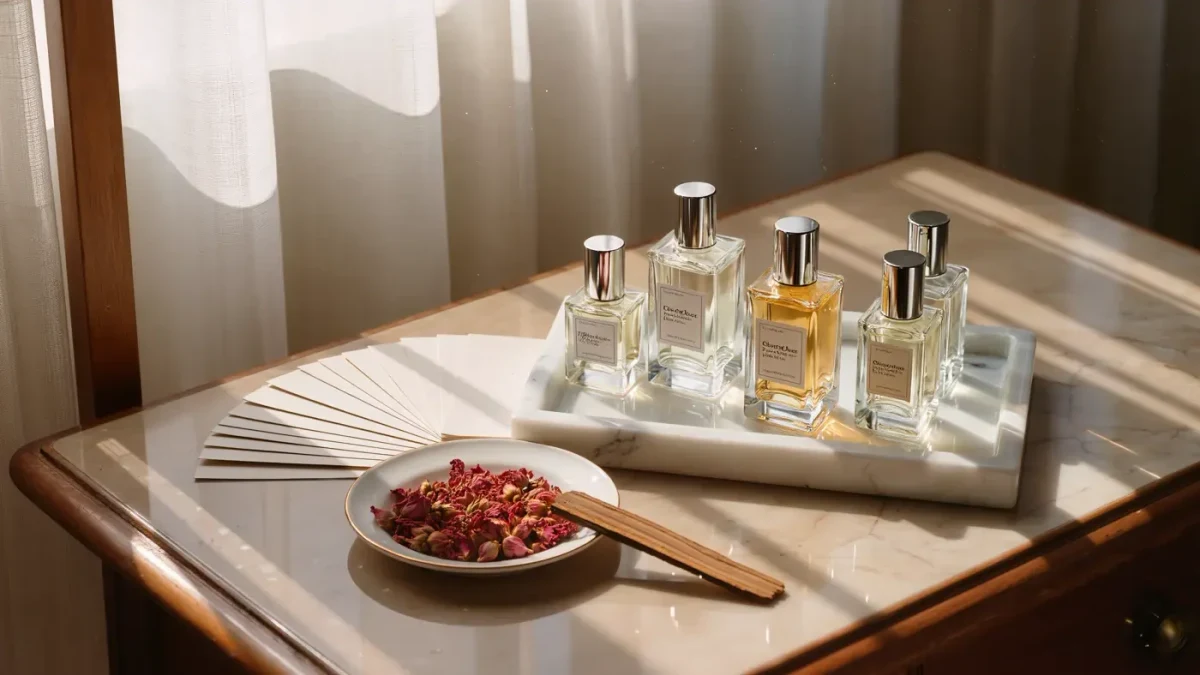
Application order follows the same logic as solo perfume: oils and heavier bases on moisturized skin first, sprays after, and pulse points last. If the combo works on a paper test strip, it will usually work on skin — but skin is the final judge, since body chemistry bends every formula.
Which fragrance families layer best together?
The wheel does the matchmaking. Families that neighbor each other — florals with florals, woods with woods — blend safely. Families in adjacent territories create the interesting bridges: vanilla with citrus, leather with rose, amber with almost anything warm. The classic high-risk pairings are two heavy bases fighting for the same space — oud plus gourmand plus musk is not a personality, it is a fire alarm.
A few combos are near-universal starting points: a clean musk under any floral to blur its edges, a single-note vanilla beneath a fresh citrus to give it a floor, a woody base under a rose to pull it toward the Middle Eastern register. Start there and deviate by one variable at a time.
Why did layering explode in the 2020s?
Because the collection got bigger than the occasions. A decade of decants, discovery sets, and shelf-filling purchases left most fragrance fans owning more scents than days in a month, and layering converts that surplus into novelty without a new purchase. The psychology is collector logic: combinations multiply. Twenty bottles become hundreds of potential pairings, and suddenly the shelf feels infinite instead of indulgent.
The culture also shifted toward ownership — the same impulse behind interior styling and capsule wardrobes. In an era where a viral scent sells out globally within weeks, the one combination nobody else is wearing is the last true flex. Signature used to mean one bottle. Now it means a ratio.
Can you layer a perfume with body lotion?
Not only can you — it is the gentlest possible version of the method. Unscented lotion under a fragrance extends wear by giving the oils something to hold; scented lotion from the same line deepens the scent's own pyramid. The classic mistake is mixing two strong scented products from different brands; one should be supporting cast. Lotion is the bassline, perfume is the melody, and one of them needs to stay quiet.
How many fragrances can you layer at once?
Two is the sweet spot; three is the expert ceiling. Past that, the top notes collide, the wear becomes unpredictable across skin types, and nobody near you in an elevator benefits. If a three-scent stack is genuinely calling to you, make two of them light — a musk and a citrus — and let one formula carry the structure. Depth comes from the base you choose, not the count you reach.