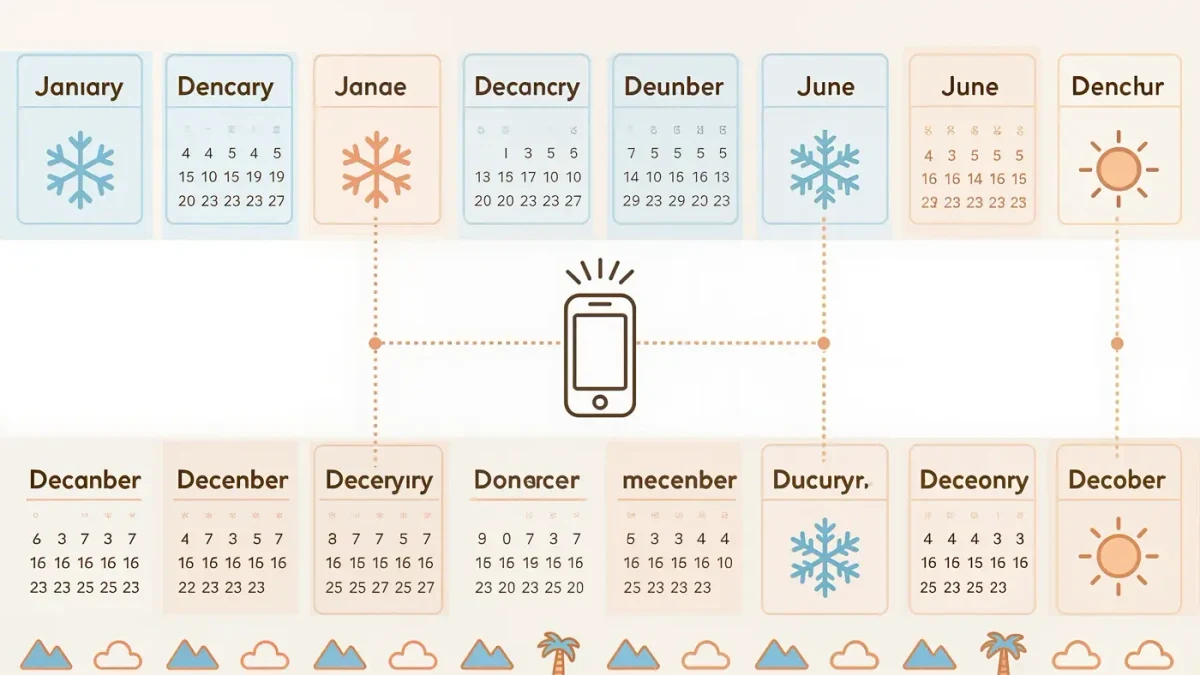
Winter skincare advice keeps arriving in July for one structural reason: the internet is global and the calendar is not. When northern-hemisphere creators post heating-season barrier content in December, platforms recirculate it to southern-hemisphere readers heading into their own winter in June — and to anyone in a tropical climate for whom 'winter skin' is a rumor. So the July flood of cold-weather routine advice is not a mistake or a conspiracy. It is the mirror: someone else's December, arriving on your feed six months late or six months early, with no metadata to tell you which.
The fix is a reading skill, not a complaint: learning to sort seasonal advice by your climate and your skin, not by the post date.
Why does the advice calendar never match yours?
Three offsets stack. Hemisphere: December content suits readers south of the equator in June, and vice versa — so half the planet is always out of season for half the content. Latitude and climate: 'winter' means something different in Oslo, Los Angeles, and Singapore, yet the advice ships as one genre. And platform mechanics: seasonal content resurfaces on annual cycles regardless of your location, because recommendation systems optimize for engagement recency, not for your weather. The result is a feed where it is always simultaneously winter somewhere and therefore always winter somewhere in your scroll.
Nothing in that pipeline is checking whether your city clicked on the heating yet.
Which advice is season-proof anyway?
More of it than the packaging implies. The mechanism-level claims transfer across calendars: cold dry air raises water loss through skin, so moisture strategy matters whenever your environment is dry — winter outdoors, but also summer air conditioning, airplane cabins, and desert climates year-round. High UV raises pigment risk, which matters in every hemisphere's bright months and, and cold, dry air — the same conditions the Mayo Clinic lists among dry-skin causes — strips surface moisture, on any calendar. Humectants onto damp skin, occlusives to seal, sunscreen daily: the physics does not check the date.
What genuinely is calendar-bound is narrower than the content suggests: the specific weeks when your own heating clicks on, your own humidity drops, and your own UV index peaks. Those dates vary by city, not by content season.
How should you actually time a routine switch?
Watch your skin and your thermostat, not the trends page. Three honest signals that your environment — not the calendar — changed: your regular moisturizer stops lasting the day, actives that were fine start stinging, or oil arrives in volume it did not have last month. Respond in order: adjust the moisturizer texture first, dose the actives second, swap the cleanser last. The two-week transition habit beats any seasonal drop date.
Travel exposes the logic best. Fly from a humid coastal summer into a dry continental winter and your skin runs the whole year's adaptation arc in four days — which is why the carry-on trio is a richer cream, a humectant serum, and the SPF you were already wearing.
Is there any real harm in off-season advice?
Mostly it is noise. But two cases waste real money and skin patience. First, unnecessary escalation: buying 'winter barrier repair' products in your humid summer because the content was compelling, then layering occlusives your climate actively punishes. Second, missed windows: southern-hemisphere readers who absorb 'winter prep' as a December concept entirely miss their own April dry-down. Off-timing advice is not dangerous — it is just easy to obey at the wrong moment and call your skin difficult for objecting.
Why does the industry ship seasons at all?
Because seasonal framing sells: 'winter skin rescue' and 'summer glow' bundles convert urgency that a generic 'match your moisturizer to your humidity' never will. The seasonal drop is now a fixed beat of the beauty calendar — winter edits landing in the same October slot every year, summer protection pushes arriving with the northern May. None of it is written for the reader in Buenos Aires or Bangkok. It is written for the hemisphere where most of the ad budget lives, which is why your feed's weather and your window's weather disagree.
Quick answers
How do I know if advice applies to my climate? Translate it into mechanisms. Ask what the advice is actually fixing — low humidity, high UV, heat, friction — then check whether your current environment has that condition. If your July is humid and 30 degrees, December's 'cracked winter hands' content does not apply to you yet, wherever it was filmed.
Does skin care advice from the southern hemisphere run six months ahead? Yes, by the calendar — Sydney's July is Los Angeles's January — but not by climate type, which depends on latitude and region more than hemisphere. The useful move is following creators whose city matches yours, or at least whose season matches, rather than whose production quality does.
Should I save winter posts for later? Effectively, yes — treat seasonal content like a recipe clipped out of season. Bookmark it against the week your own weather triggers it: heating on, humidity dropped, skin tight by noon. The advice's shelf life is your forecast, not the platform's archive.