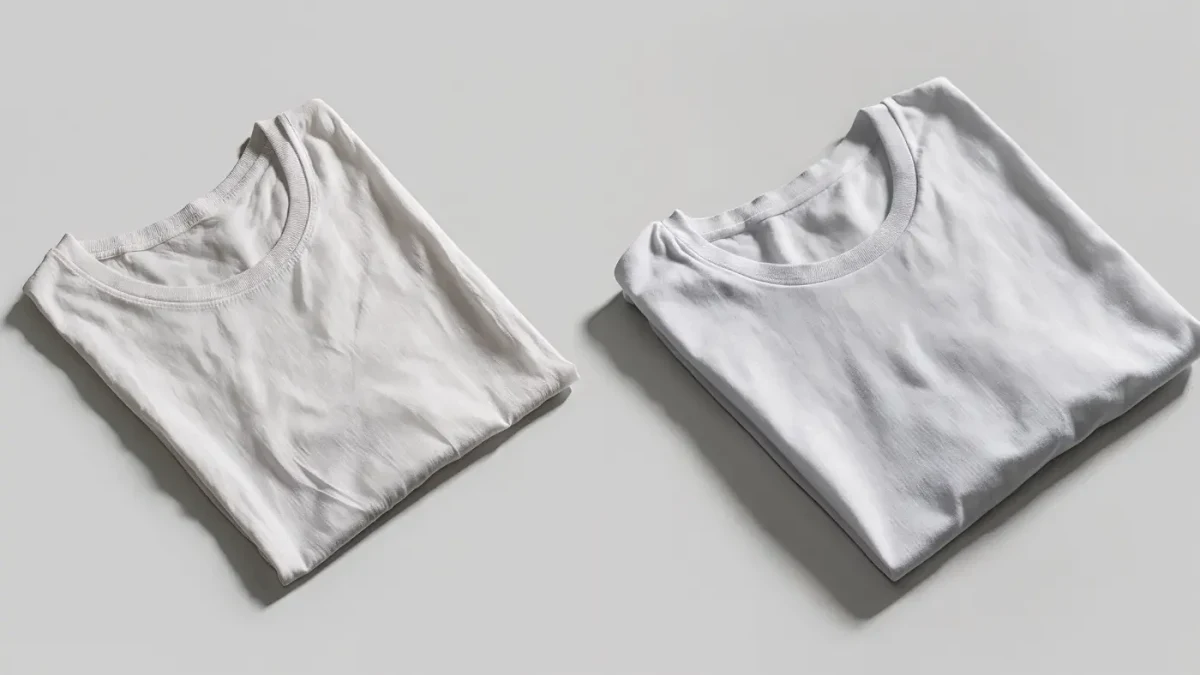
A white t-shirt costs $5 or $95 because the shirt is not what you're buying. The $5 version is a commodity: low-grade short-staple cotton, a loose ambiguous cut, and a supply chain engineered to the last cent, where the shirt itself is often the smallest line in the price. The $95 version prices in long-staple cotton, a cut someone actually drafted on a body, heavier fabric, and a brand story — plus, depending on the label, better wages somewhere in the chain. Between them sits the entire clothing industry in miniature. The shirt is identical on a hanger and completely different on a body and in a drawer, three years out.
What actually changes with fabric quality?
Start with the fiber. Cheap tees use short-staple cotton — short fibers that poke out of the yarn, creating the fuzz that pills after five washes. Premium tees lean on long-staple varieties like Pima and Egyptian cotton, whose longer fibers spin into smoother, stronger yarns that stay flat and soft for years. Then the knit: fabric weight is measured in GSM (grams per square meter), and the gap is physical — a fast-fashion tee can run under 140 GSM, sheer enough to read as a rumor, while a quality tee typically sits from 180 GSM up, which is why it hangs instead of clinging and survives the washing machine's weather systems.
Neckline construction is the tell you can check in-store: a bound or ribbed collar with visible reinforcement holds its shape; a single flimsy seam is a countdown clock to the Bacon Neck economy.
Does the cut really justify a higher price?
More than the fabric does, honestly. Cheap tees are cut from block patterns graded across sizes with minimal shaping — that's why they bag at the chest, pull at the shoulder, and generally hang like a laundry bag. Expensive tees are drafted: the shoulder seam sits exactly on the shoulder point, the body has subtle taper, the sleeve hits the mid-bicep, the neckline is chosen rather than defaulted. None of this shows on a hanger, which is precisely why the hanger is a liar and the fitting room is not.
The unglamorous truth of the premium tee is that you're paying mostly for geometry. Geometry is what makes a plain shirt look designed instead of issued.
How much of a t-shirt's price is labor?
Less than anyone wants, on both ends. In conventional fast fashion, the garment worker's cut of a $5 tee is estimated in single-digit cents — the industry's documented dirty secret, covered for years by outlets tracking supply-chain wages — while at the premium end, even a $95 shirt rarely sends more than a few dollars to the person who sewed it; the money buys better conditions and auditing, sometimes, but the margin mostly funds fabric, brand, and retail. Fair-wage certification exists and costs real money, which is one honest reason a tee crosses $50. Everything else crossing that line is storytelling.
Is the $95 tee actually worth it?
Sometimes — on cost per wear, it can be the cheapest shirt you own. A well-made heavyweight tee survives dozens of times more wash cycles than its fast-fashion counterpart and looks better while doing it, so a $95 shirt worn weekly for four years undercuts a $15 shirt replaced every eight months. But the correlation between price and quality breaks above roughly the $60–$80 mark, where you're increasingly paying for the logo embroidered on the chest — literal brand equity priced per unit. The sweet spot for genuinely better materials and cut is well below the luxury tier; plenty of the internet's favorite 'perfect tee' candidates retail in the $30–$60 range.
Why does the cheap tee fall apart so fast?
By design and by economics. Thin yarn, loose knit, and minimal stitching — single-needle hems, fewer stitches per inch — mean the garment is one diagonal stretch away from a twisted side seam. Add aggressive shrinkage from low-grade, inadequately pre-shrunk cotton, and the tee you bought is not the tee that comes out of the first hot wash. The $5 shirt is engineered for the purchase, not for the ownership; its entire business model happens before you leave the store.
What should you check before buying a white tee?
Four things, sixty seconds. Hold the fabric against light — if your hand ghosts through it, pass. Stretch the neckline and check it snaps back — recovery is everything. Read the tag for 100 percent cotton or a quality blend, and note the country-of-origin and care instructions, which honest brands make legible. Then try it on and check the shoulder seam placement, because that single point decides whether the shirt was drafted or just distributed. White specifically also asks one more question: is it thick enough to be opaque, because no layering system fixes translucency.
FAQ
Does expensive cotton really last longer? Yes, measurably. Long-staple fibers like Pima and Egyptian cotton produce smoother, stronger yarns that resist pilling and thinning, so the shirt keeps its surface and shape through far more wash cycles than a short-staple fast-fashion tee, which starts degrading almost immediately.
What is a good GSM for a t-shirt? For a substantial everyday tee, aim for roughly 180 GSM and above; under 150 GSM you're in sheer summer territory that clings and wears quickly. Heavier weights from 220 GSM up read boxy and structured — a deliberate look, not a defect.
Are premium t-shirts more sustainable? Not automatically. Durability is the strongest sustainability argument — one shirt worn for years beats ten shirts worn for months — but fabric origin, dyeing, and labor practices vary wildly at every price. Check for specific certifications rather than trusting the price tag to be a conscience.