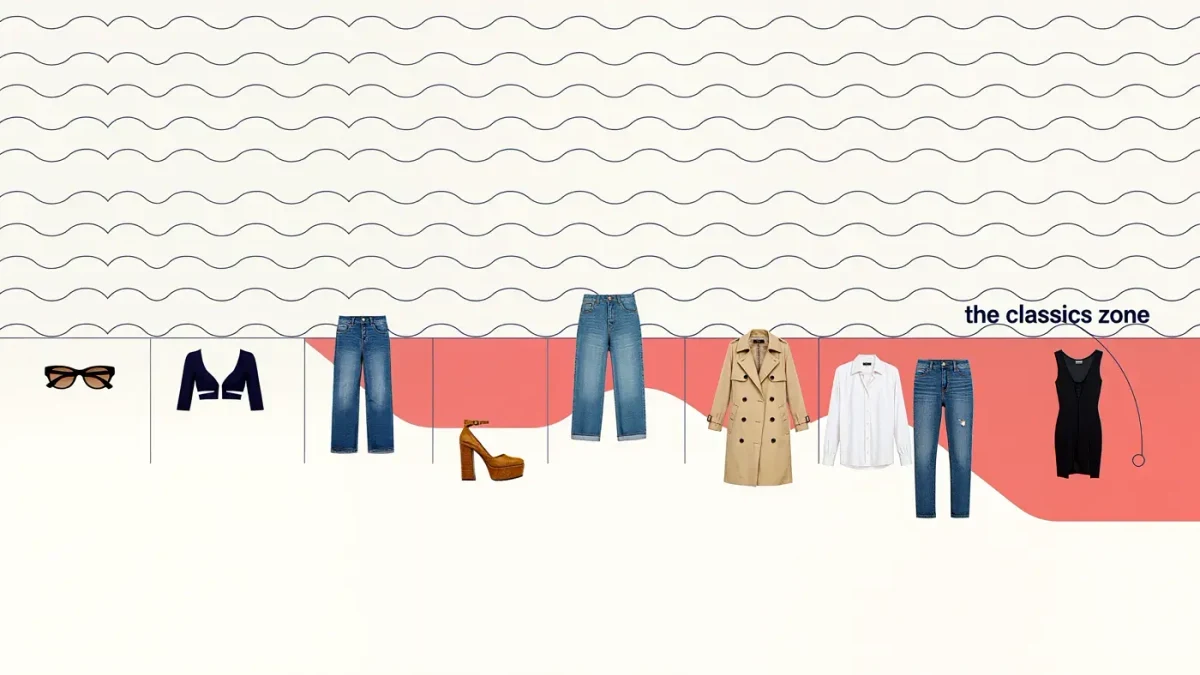
A piece is timeless when it solves a function without announcing a date: the trench, the white shirt, the straight jean, the little black dress — silhouettes that have survived every cycle since the twentieth century because they answer a permanent question (what do I wear over this, under this, to this). A piece is trendy when its design features are legible as a timestamp: the exaggerated barrel-leg of the mid-2020s, the micro-sunglasses moment of the late 2010s, the shrug, the very-specific heel. The practical test takes ten seconds: if you can name the year a garment is from by its details alone, it's a trend piece; if you can't, it's infrastructure. Both are allowed in the closet — they just belong at different price points and different corners of it.
What actually makes a piece timeless?
Three traits, and none of them is 'boring' by accident. First, function-first design: a trench's storm flap and gun patch were field equipment before they were fashion, and equipment doesn't expire. Second, mid-scale proportion — timeless pieces sit at historically stable ratios, neither the extreme volume nor the extreme slimness of any given moment. Third, neutrality of signifier: no loud hardware, no novelty treatment, no visible logo doing the talking. Timelessness is basically design at the volume of a background track — versatile enough to be reinterpreted by every decade, which is exactly what happens. Every 'return of the trench' headline is the same coat refusing to leave.
What makes a trend piece worth buying anyway?
Joy and timing, honestly priced. Trends are how fashion breathes, and the right trend piece at the right moment can carry a whole wardrobe's worth of current-ness on its own — one barrel-jean or one sculptural shoe makes every timeless thing you own read as 'now' instead of 'archive.' The rule is ratio and spend: buy trends at the shallow end of your budget, in the one or two slots your outfit rotation has open, and expect a service life of one to three seasons. A trend is a rental of the zeitgeist. Pay rent prices.
The exception worth knowing: some trends graduate. Wide-leg trousers moved from trend to staple across the 2020s; so did the chunky loafer wave before it. Trends that resolve a real comfort or proportion problem tend to stick around — they didn't just look new, they worked better.
How do you spot a trend that will last more than a season?
Run three checks. Comfort check: does it solve something — pockets, ease of movement, a proportion that flatters more bodies than the last version? If yes, it has a future; if it's purely visual, it doesn't. Mirror check: does the trend echo a shape with historical staying power (the wide leg existed in the 1970s, the 1990s, and the 1840s), or is it genuinely unprecedented? History rhymes, and rhymes replay. Floor check: could a person wear this in five years without it reading as a costume? The micro-tinted sunglasses fail that check instantly; the oversized blazer passes it every time.
Is the 'trend cycle' speeding up?
Yes, measurably, and the cause is distribution. Social platforms compress what used to be a multi-year fashion cycle — the old runway-to-high-street pipeline took seasons; a TikTok sound or a single viral fit can globalize a micro-trend in weeks, and by the mid-2020s commentators were routinely tracking 'micro-trends' with lifespans measured in months. The consequence for your closet is arithmetic: faster cycles mean any purchase justified by trendiness depreciates faster than ever, while the timeless layer's value holds steady. The speeding cycle doesn't punish having fun with fashion. It punishes paying full price for it.
How should a wardrobe split between timeless and trendy?
The working split is roughly 80/20, weighted toward your highest-wear categories. Outerwear, tailoring, denim, and shoes want to be nearly all timeless, because they're the pieces doing daily work and setting your silhouette. The trend allocation lives where it's cheap to be wrong: knit tops, accessories, jewelry, one pair of the season's sneaker. Accessories are the classic entry point — a trend bag or a trend earring delivers the current-ness signal at a fraction of a trend coat's cost, and can retire gracefully when its moment ends.
Can a trendy item become timeless?
Individually, almost never; as silhouettes, occasionally. The garment you bought in a specific season will always carry that season's cut and detailing — you can't launder provenance out of a piece. But the shape it belongs to can graduate into the canon if enough designers keep iterating on it: the t-shirt itself was once subcultural, denim jacket went from workwear uniform to permanent furniture, the white sneaker climbed from athletic footnote to wardrobe load-bearing wall. That's the arc to watch for when deciding whether this season's experiment deserves a second season.
FAQ
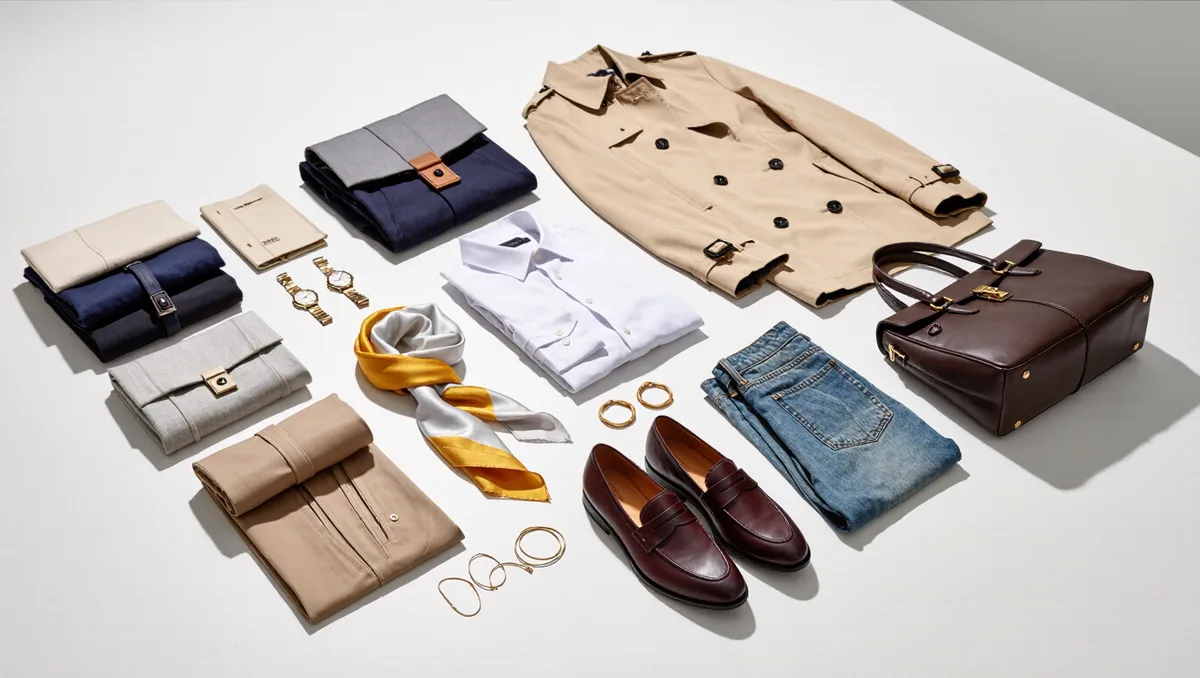
What are examples of timeless wardrobe pieces? The consistent canon: trench coat, white button-down, straight or slim dark denim, little black dress, crewneck knit, tailored blazer, white leather sneaker, plain leather bag, simple gold or silver hoops. Their shared trait is function-first, mid-proportion design with no dateable signifiers — each has remained wearable across many decades of cycles.
Is it bad to buy trendy clothes? No — trends keep a wardrobe alive, and joy is a legitimate purchase reason. The discipline is price and ratio: buy trends cheaply, in small allocation (around 20 percent of the wardrobe), and expect a one-to-three-season service life. What's expensive is paying investment prices for a rental.
How do I know if a trend suits me before buying? Try the full outfit at home — the trend in isolation is meaningless, since trends work or fail in combination with what you own. If you can build two complete outfits with pieces already in your closet, and the mirror test passes in daylight, it earns a spot. If it needs new purchases to function, it's costlier than it looks.