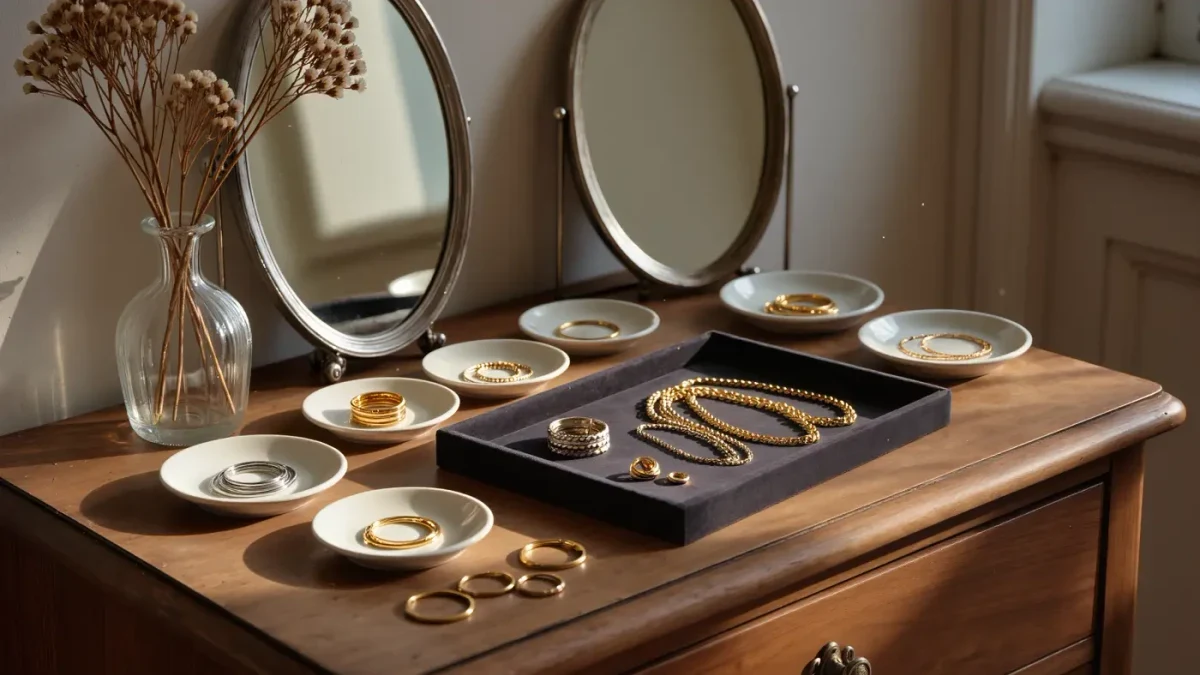
The classic stacking rules — odd numbers of rings, one metal per wrist, a single statement piece, bracelets on one arm only — are useful training wheels and nothing more. They exist to give beginners a confident default, the way recipe measurements exist until you learn what dough should feel like. The stacks that actually look editorial break at least one rule on purpose: mixed metals, matched sets, two statements, the whole jewelry box on one hand. The real mechanics underneath the rules are contrast, repetition, and negative space, and once you can see those, the commandments become a menu instead of a law. Here's what each rule was protecting — and when it's safe to fire it.
Rule one: mix metals, or don't?
The matched-metals rule came from a formal era when jewelry signaled a 'set' — and it's the most safely breakable rule on the list. Mixed gold and silver reads deliberate as long as there's a bridge: a two-tone piece, a diamond that plays with everything, or a shared finish (all pieces either polished or all brushed). What reads accidental isn't the mixing, it's the half-mixing — one lonely silver ring in an otherwise gold stack looks like a mistake, while three deliberate silver pieces in a gold crowd look like a decision. Contrast needs critical mass.
Does the odd-number rule actually matter?
It's composition folklore, borrowed from floral design and photography, and it works because asymmetry looks alive. Odd counts create a natural focal point; even counts split the attention down the middle. But the rule collapses at higher counts — a stack of five is visually 'a stack,' and nobody's counting parity at six. Use odd numbers as a starting recipe for small stacks of two or three, then graduate to what stylists actually do: build around one anchor piece and add until it feels busy, subtract one, stop. The eye is the only judge that matters.
Can you stack statement pieces together?
Yes — the 'one statement per outfit' rule assumes your statements are competing in the same lane. Two statements in different zones don't fight; they duet. Chunky earrings plus a stack of slim rings works; two chunky cuffs on the same wrist is a collision. The principle is lane separation: one statement per visual zone — ears, neck, each wrist, each hand. Coco Chanel's famous advice to remove one accessory before leaving the house survives precisely because it's a pacing tool, not physics; the modern edit of it is 'remove one piece per zone,' not one total.
What makes a stack look expensive?
Spacing and scale, more than price. Cheap-looking stacks share a failure mode: pieces of identical weight jammed together with no air. Expensive-looking stacks vary the scale — a thin band, a mid ring, one hero piece — and leave breathing room between bracelets, or use pieces with built-in spacing like bangles and chains. Texture mixing does the same work: smooth metal, braided chain, a stone, a pearl, each giving the eye somewhere new to land. This is also why the uniform thin-band stack went viral in the first place — it's the cheapest possible way to look composed, and the jewelry counter at every fast-fashion store knows it.
How many rings or bracelets are too many?
The honest ceiling is function and self-consciousness, not arithmetic. Rings stop working when they stop letting you use your hands — typing, cooking, shaking them — and bracelets stop when they start conducting percussion every time you move. There's also a hard practical line: anything tight enough to risk ring-removal emergencies should sit in storage, not in a stack. Culturally, the maximalist era — ears, fingers, wrists, all at once — has been fully mainstream since the 2010s and shows no sign of leaving; the 'too many' threshold moved from your grandmother's mirror to your own comfort level, and it's allowed to be anywhere.
How do you start a stack from nothing?
One anchor, three satellites. Pick a single piece you actually love — a signet, a birthstone band, a chunky chain — and build two or three quieter companions around it in a compatible finish. Stack in front of a mirror in daylight, because jewelry reads completely differently in store lighting. Then wear the stack for a full week without editing it; the pieces that annoy you by Thursday were never yours. Buy slowly and let the stack accumulate, which is also how every great vintage collection in a dealer's case got built — one good piece at a time, over years.
FAQ
Is mixing gold and silver jewelry really okay? Yes, and it's been mainstream for years. The trick is committing: bridge the metals with a two-tone piece or repeat both metals at least twice each, so the mix reads intentional. A single outlier in an otherwise uniform stack is the only version that looks accidental.
How many bracelets should you stack on one wrist? Three to five is the comfortable default — enough variation in texture and scale to look curated without turning your wrist into a percussion instrument. Go higher if the pieces are slim and quiet; go lower if one chunky cuff is doing the whole job.
Can you wear a watch in a bracelet stack? Absolutely — the watch is usually the anchor and everything else arranges around it. Keep bracelets slimmer than the watch case, put the largest pieces on either side rather than crowding the clasp, and let the watch strap set the finish the stack echoes.