The french manicure was invented in 1976 by Jeff Pink, founder of the brand ORLY, who created the natural-pink nail with a white tip as a versatile look for Hollywood costume changes — and named it 'French' because Paris runways gave it its fashionable stamp of approval. Nearly fifty years later, it remains one of the most requested nail services on the planet, currently living its latest life in chrome, glazed, and micro-tip variations across TikTok. Trends do not usually get golden anniversaries. This one has outlived the scrunchie twice.
The longevity is not an accident. The french manicure solves a problem most nail art ignores: it looks finished at a distance and invisible in a boardroom. That duality is a moat.
Who actually invented the french manicure?
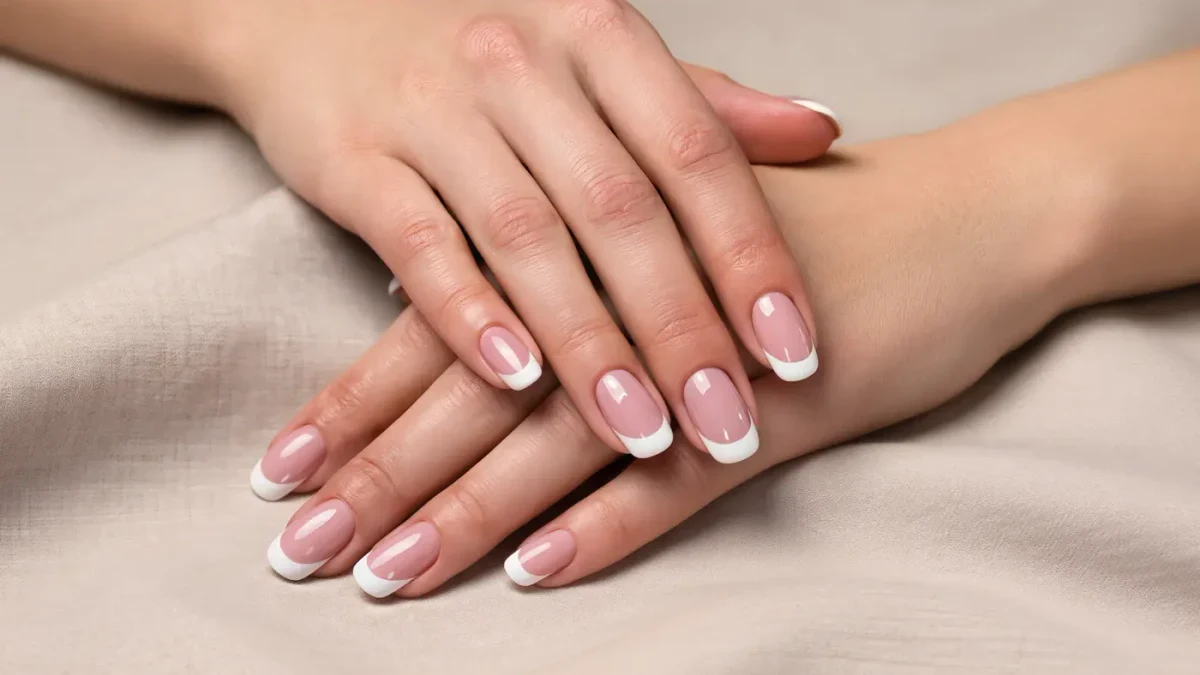
Credit goes to Jeff Pink, who founded ORLY in 1975 and developed the look the following year for film and television, where actresses needed one nail style that could carry them across multiple costumes and scenes without clashing with wardrobe. The formula was simple: a sheer nude or pink base, a crisp white free edge, and a clean smile line. Pink has said the 'French' name came after the look appeared on Paris runway models — the city functioned as a label of chic, the same way 'French' has sold fashion, fries, and kissing.
It is one of the rare beauty innovations with a nameable inventor, a year, and a company attached — nail culture's equivalent of a patent line. And like all good inventions, it was quickly treated as if it had always existed. By the 1980s, the look read less like a product and more like a category of hand.
Why did the french manicure become so iconic?
Because it flatters the one thing every client has — the natural nail — while signaling effort. The pink base echoes the nail bed, the white tip extends it, and the combined illusion reads as 'your hand, but rested.' In the 1980s and 1990s it became the default of weddings, pageants, and office-appropriate grooming, the look you chose when you wanted nails that photographed but did not talk back.
That respectability is exactly why the 2000s turned on it. As gel, acrylic art, and celebrity nail culture made nails a canvas, the french tip became shorthand for safe — the manicure equivalent of a mumu nail salon stereotype it never deserved. Every trend cycle needs a previous decade to mock, and for a while, the french got the job.
How did the french manicure come back?
The comeback started in earnest around 2020, when nail art exploded on TikTok and a new generation rediscovered the tip as a template rather than a rule. The 'micro french' shrank the white line to a whisper; 'glazed' versions added pearl chrome over the classic base; colored tips — red, neon, milk-bath pink — swapped the white for any shade with a pulse. Celebrity manicurists put twists on the classic on every red carpet, and the look's searchable variants multiplied into the thousands.
The smart part of the revival is that none of it required the original to die. The french manicure is the last look standing from every era it has passed through — the 1970s natural-nail movement, the 1990s minimalism, the 2020s chrome obsession. It takes whatever the decade is drinking and serves it back with a smile line.
What does a french manicure say now?
In 2026, wearing the original white-tip version reads as a deliberate choice rather than a default — a little retro, a little polish-signaling, the nail version of a trench coat. The updated tips read current. Either way, the message has flipped from 'safe' to 'in on the joke,' which is what fifty years of survival buys you. A trend that refuses to die eventually becomes a classic, and a classic gets to be ironic, sincere, or both at once.
There is a quiet lesson in the arc, too. The most durable beauty ideas tend to be the ones built on a trick of perception rather than a pigment — the french manicure is essentially an optical illusion about where your nail ends. Illusions age slowly. Neon yellow ages in six weeks.
How do you ask for a modern french manicure?
Get specific, because 'french' now covers a family tree. Decide the tip width first — micro, classic, or wide — then the color of the tip and the base, whether you want the smile line crisp or softly blurred, and your finish: glossy, matte, or chrome. Bring a reference photo, since a 1998 french and a 2026 glazed french are separated by technique as much as taste. A good tech will ask these questions; a great one will tell you which version suits your nail shape.
Is a french manicure expensive?
It is priced like any full manicure, sometimes slightly more because the smile line takes a steady hand and real time. Gel versions cost more than regular polish everywhere and always. What you are paying for is precision — the entire look lives or dies on the symmetry of two curved lines, which is harder than it looks and the reason a cheap french is always, always visible.
Why is it called a french manicure if it was invented in Hollywood?
Pure marketing, and effective marketing at that. Jeff Pink named the look after the Paris runways where it appeared on models, borrowing the city's fashion credibility for a product built in California. France supplied the name, Hollywood the use case, and the salons of the world the half-century of loyalty. The most French thing about it, in the end, is how well it sells.