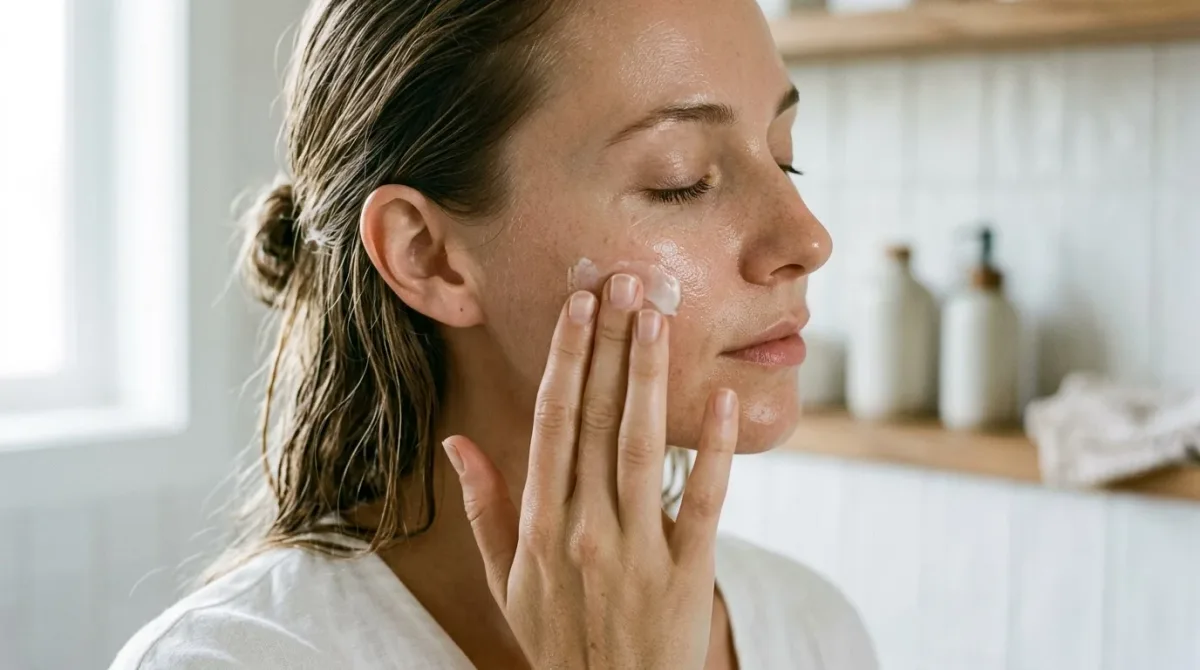
Scroll through any skincare corner of the internet for more than a minute and the phrase "skin barrier" will find you. It shows up in captions about redness, in comment sections defending gentle routines, in product copy for basically every new moisturizer. The term gets used constantly, but rarely explained. Here's what it actually means.
What is the skin barrier?
The skin barrier is the outermost layer of skin, known scientifically as the stratum corneum. According to Healthline, it functions like a brick wall: tough, flattened skin cells act as the "bricks," held together by lipids that act as the "mortar" (SRC-01). That structure keeps two things happening at once — it blocks environmental irritants, allergens, and pathogens from getting in, while keeping water from escaping out.
A 2023 review published in the journal Skin Pharmacology and Physiology, co-authored by dermatologists Jeffrey Rajkumar, Neha Chandan, Peter Lio, and Vivian Shi, breaks the barrier down further into four interdependent layers: physical, chemical, microbiologic, and immunologic, all working together to maintain what the researchers call homeostasis. When any one of those layers is disrupted, the whole system becomes less effective at holding onto moisture and fending off outside stressors.
Why is it suddenly everywhere online?
Part of it is a genuine shift in how younger skincare users talk about their skin. Instead of chasing aggressive routines with multiple exfoliating acids and retinoids stacked back to back, a lot of the current conversation is about restraint — using fewer, more deliberate products and giving skin room to recover. "Barrier" became the shorthand for that recovery state, a way to talk about skin health that isn't tied to a specific concern like acne or wrinkles but to the skin's baseline resilience.
It also helps that the term has real clinical grounding, unlike some skincare buzzwords that fade as fast as they trend. Because the barrier concept comes from actual dermatological research rather than a marketing invention, it has stuck around across seasons of trend cycles instead of being replaced by the next one.
What actually damages the skin barrier?
Healthline lists a mix of environmental and behavioral triggers: extreme humidity or dryness, harsh soaps and detergents, over-exfoliation, prolonged steroid use, allergens, sun exposure, and stress (SRC-01). Genetic predisposition matters too — people with conditions like eczema or psoriasis are more prone to a compromised barrier to begin with.
The overlap with skincare habits is the part worth sitting with. Layering multiple active ingredients, cleansing too frequently, or using physical scrubs daily can strip the lipids that hold the barrier together faster than skin can replace them. None of this means actives are bad — it means the barrier is the thing that determines how well skin tolerates them in the first place.
How do you know if your barrier is compromised?
Signs include persistent dryness or flaking, a tight or stinging sensation after applying products that never used to bother you, unexplained redness, increased sensitivity, and breakouts that don't respond to usual treatment (SRC-01). These aren't diagnostic on their own — persistent or severe symptoms are worth bringing to a dermatologist — but they're the pattern to watch for.
What ingredients actually help repair it?
The 2023 review identifies three functional categories of repair ingredients: occlusives, which seal the surface of the stratum corneum to prevent water loss; humectants, which draw moisture upward from deeper skin layers; and emollients, which integrate directly into the stratum corneum to smooth and reinforce it. The researchers note that moisturizers formulated closer to skin's natural pH better support enzymatic function and the skin's own ceramide production.
Ceramides specifically get singled out often because they're not an add-on ingredient so much as a core structural one. Skincare brand CeraVe, whose formulations are built around them, states that ceramides make up roughly 50% of the lipids in the skin's protective barrier and that its products use three ceramide types the brand describes as chemically identical to those found naturally in skin, delivered through a slow-release delivery technology (SRC-03). That's the brand's own claim about its formulation, not an independent clinical finding, but it explains why ceramides show up in so much of the repair-focused product conversation.
Beyond ceramides, Healthline points to plant oils like jojoba and sunflower for their fatty acid content, along with humectants such as hyaluronic acid and glycerin, and heavier occlusives like petrolatum, which the outlet notes can block up to 99% of water loss when applied over damp skin (SRC-01).
Does a barrier-focused routine mean giving up actives?
Not necessarily. The point isn't to abandon retinoids or acids permanently — it's to sequence them with enough recovery time that the barrier isn't under constant assault. A simplified routine for a stretch, built around a gentle cleanser and a ceramide-rich moisturizer, gives the lipid layer room to rebuild before actives get reintroduced. Think of it less as a restriction and more as maintenance, the same way any system needs downtime to keep functioning under regular use.
For a related direction perspective, read Skin cycling wasn't invented by TikTok — here's who actually made it up.
For more context, read how to read a sunscreen label without getting played.