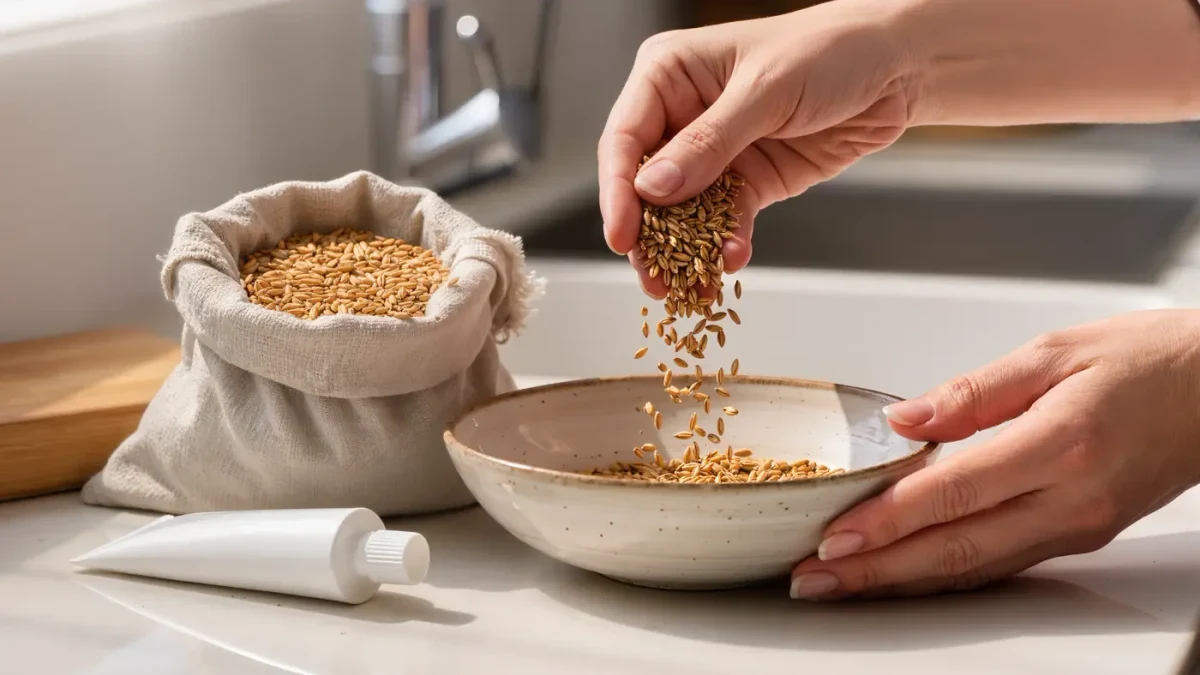
Azelaic acid is a dicarboxylic acid found naturally in grains like barley and wheat, and it is the working-class hero of the acid shelf: dermatologist-prescribed at 15% for papulopustular rosacea under the brand Finacea, approved at 20% for acne as Azelex in the United States, and sold over the counter at 10% and below. It calms redness, unclogs, and visibly evens tone with a gentleness the louder acids rarely manage. In a market that monetizes intensity, an acid whose headline is 'tolerated well' was never going to trend first.
Which is precisely why it deserves the explainer. Below: what azelaic acid actually does, how it compares to its famous cousins, and who should reach for it first.
What does azelaic acid actually do?
Three documented jobs. One: it is keratolytic, meaning it helps loosen the debris that clogs pores — a milder version of salicylic acid's specialty. Two: published clinical research has associated it with reduced growth of the bacteria involved in acne, including work on Propionibacterium acnes reported in dermatology journals since the 1980s. Three — the quiet flex — studies including a 1995-published analysis by Fitton and Goa in the journal Drugs found azelaic acid inhibits tyrosinase, the enzyme driving pigment production, which is why dermatologists reach for it in melasma and post-inflammatory hyperpigmentation protocols.
Redness, congestion, and dark marks in one molecule. No other common acid runs that exact portfolio.
How does it compare to glycolic and salicylic?
Glycolic acid is the exfoliator; salicylic is the degunker; azelaic is the peacemaker. Compared to glycolic, it stings far less because it does not rely on low-pH aggression to work. Compared to salicylic, it adds the pigment and redness stories salicylic does not have. Compared to both, its evidence base is smaller but unusually specific — rosacea and hyperpigmentation are where the prescription-strength data lives, at 15–20%.
The honest trade-off: results run slower. Where glycolic announces itself in two weeks, azelaic's tone work in the published studies typically ran on three-to-six-month timelines. It is an ingredient for people who can wait.
How do you use it in a routine?
Over-the-counter formulas — the 10% suspensions and creams that spread across shelves after The Ordinary launched its now-canonical version in 2017 — slot in after cleansing, before or instead of moisturizer, once daily to start. It layers safely with niacinamide, hyaluronic acid, and sunscreen. With other exfoliating acids, alternate nights rather than stack; the combination is not dangerous, just pointless and itchy.
A consistency note: many 10% formulas have a silicone-heavy, almost primer-like texture that pills under heavy serums. If it pills, it goes on last and acts as a finishing layer — the formula is flexible, the order is negotiable, the habit is not.
Is azelaic acid safe for sensitive skin and pregnancy?
Azelaic acid has a low-irritation profile in the published literature, which is why dermatologists so often recommend it for rosacea-prone and easily flushed skin in the first place. On pregnancy: topical azelaic acid is among the actives commonly cited in dermatology sources as considered compatible with pregnancy — but that is a conversation for your doctor, not a decision off a magazine page. The same applies to pairing it with prescription retinoids; plenty of derm-supervised protocols do it, none of them should be self-assembled.
Why did it stay underrated for so long?
Cultural timing, mostly. Azelaic acid's evidence base is European and clinical — much of it published decades before TikTok existed — so it never had a viral origin story, just a prescription pad. When the 2020s pivot toward barrier-gentle skincare arrived, the ingredient was already sitting there, fully researched, looking like an overnight discovery to a generation that had only ever heard of glycolic. The most boring truth in beauty: nothing about it changed except the audience.
Quick answers
Can azelaic acid cause purging? A mild adjustment period is possible since it speeds pore clearing, but true purging is far less common than with retinoids. If breakouts continue past four to six weeks, the culprit is more likely the formula base or another product in the rotation than the acid itself.
Should I choose 10% or 15–20%? Start at 10% over the counter; it is where tolerance and habit form. The 15% gel and 20% cream are prescription-strength products for rosacea and acne in many countries, and they earn their strength under a dermatologist's watch. Escalate by conversation, not by checkout page.
Does azelaic acid thin or sensitize skin to sun? It is not a photosensitizer in the classic acid sense, but pigment-prone skin still needs daily sunscreen — that rule predates and outlives every ingredient in this article. Consider azelaic acid the evening-out tool and SPF the reason the evening-out sticks.