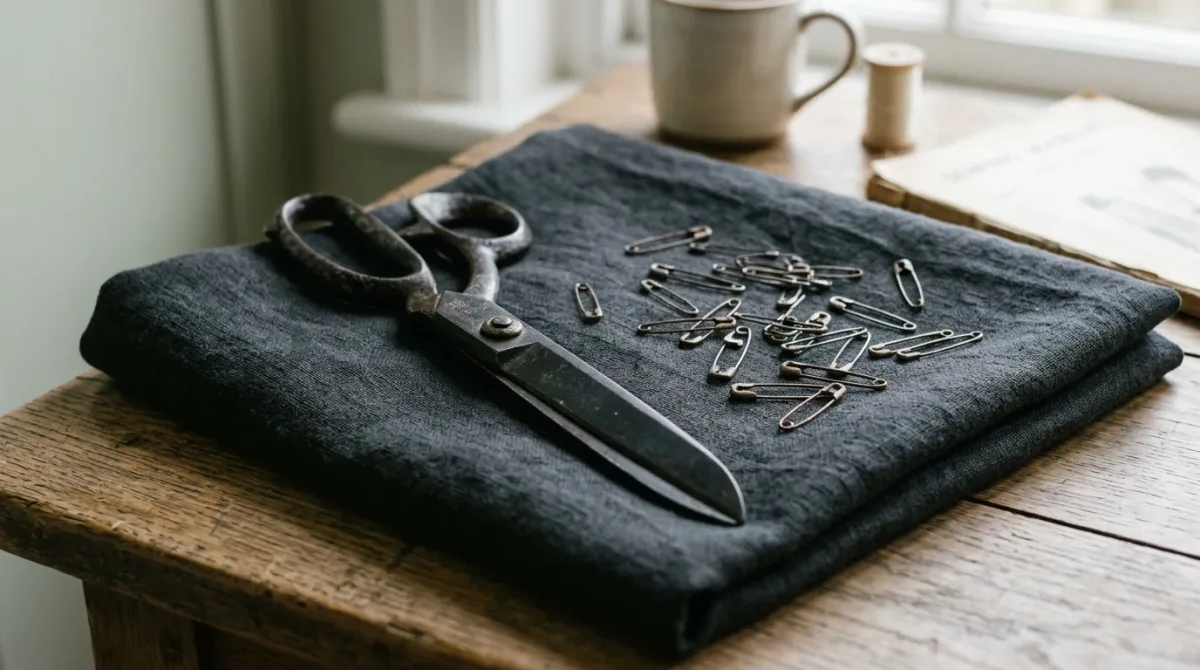
Vivienne Westwood is the designer who turned punk from a scene into a cutting technique — starting at 430 King's Road, London, where the shop she ran with Malcolm McLaren cycled through names (SEX by 1975, then Seditionaries) and sold the visual arsenal of early British punk, as documented in the Victoria and Albert Museum's Westwood retrospectives and her own published accounts. The bondage trousers, the slashed tees, the safety-pin as fastener: those originated in that shop's short, loud run, per the V&A's collection record. Every "edgy" retail rack since is downstream.
This profile is built from documented sources — museum collections, published interviews, obituary records — not from invented presence at any show or scene. Westwood died in December 2022, and the obituaries' consensus, from the Guardian to the BBC, is part of the record cited here.
What did the King's Road shop actually produce?
Clothes as confrontation, manufactured in small runs. The shop's documented output across its 1970s name-changes included fetish-derived garments repurposed as streetwear — leather, studs, straps, explicit graphics — with the Sex Pistols, managed by McLaren, as the walking advertisement, per the V&A's published history of the period. The design method was appropriation with a smirk: taking fetishwear's hardware and punk's cut-up graphics and stitching them into wearable arguments.
The lineage point: this was not costuming. It was pattern-cutting — real construction knowledge applied to provocation, which is why the clothes survived the scene that made them. Museums hold them now; that is what happens when a subcultural garment is also a well-cut one.
How did punk become a fashion language?
Through a documented sequence, dated from the museum and press record:
- 1971 — Westwood and McLaren open the shop at 430 King's Road (first as "Let It Rock"), selling 1950s revival and early originals, per the V&A's chronology.
- 1975 — the shop becomes SEX; fetishwear vocabulary enters the street, per the same record.
- 1976 — Seditionaries-era graphics and the bondage trouser; the Sex Pistols carry the look into the national press.
- 1981 — Westwood's first catwalk collection with McLaren, Pirate, exits pure provocation for historical referencing; the pattern-cutter shows her hand.
- 1985 onward — the Harris Tweed and Mini-Crini eras establish Westwood as a historical-referencing designer whose roots stayed visible, per the V&A retrospectives.
Why does it matter to alternative fashion now?
Because the vocabulary is permanent. Studded leather, the safety pin, the slashed and reassembled garment, distress as decoration — all of it traces to that shop and its immediate successors, and the fashion industry has reissued the ideas roughly every decade since, from 1980s Japanese deconstruction to current runway distressing. The BBC's obituary coverage in December 2022 catalogued the reach plainly: a designer who began by offending the establishment and ended a dame of it.
The honest limit: Westwood's later work is not punk, and she said so herself across decades of interviews — the provocation was a beginning, not a cage. What transferred permanently was the method: subculture's raw materials, treated with tailor's respect. That method — not any single garment — is her standing influence on every label covered on this site that cuts dark clothes properly rather than printing darkness onto plain ones.
For more context, read Top: Fashion and Trends.
For more context, read Title: Fashion and Guide.