New York Fashion Week's schedule traces back to Press Week, a publicity event launched by fashion publicist and future CFDA founder Eleanor Lambert in 1943 — and the Council of Fashion Designers of America (CFDA) still runs its official successor today, on a calendar that just went digital for the first time in its history. That's not a metaphor. Until recently, the schedule that decides when hundreds of designers show their collections lived on paper, and before that, on one woman's typewriter.
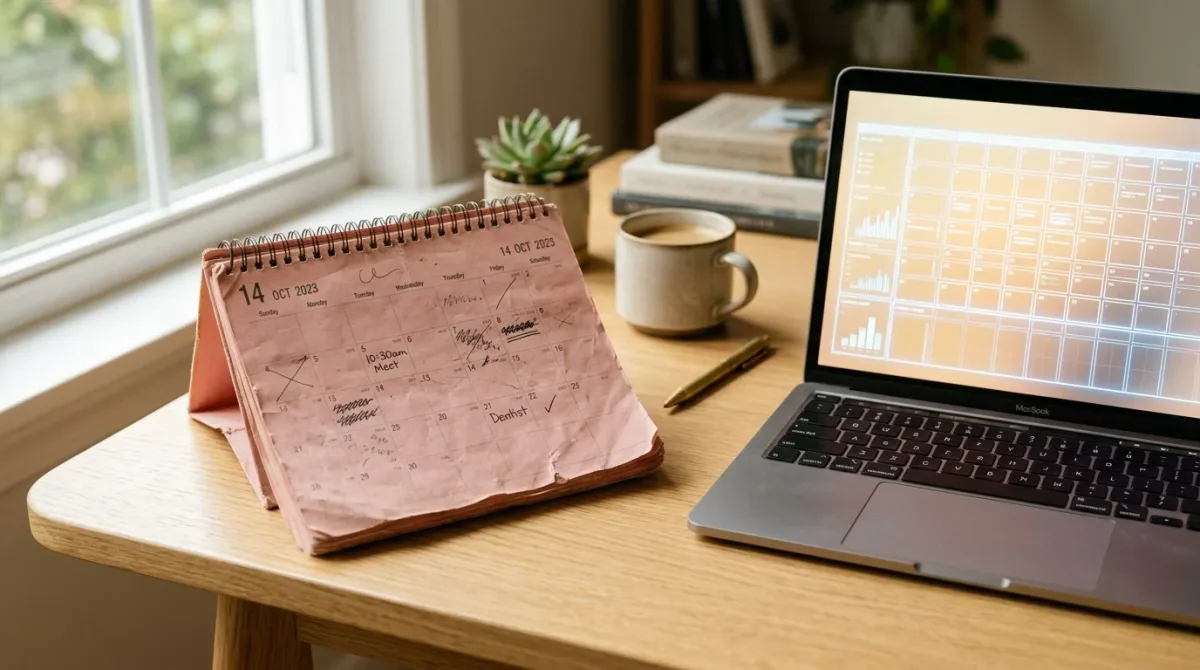
The paper part starts with Ruth Finley. She created the original Fashion Calendar in the early 1940s — early editions survive from 1941 — and ran it more or less solo for over seventy years, printed on the distinctive pink pages the industry came to recognize on sight. It wasn't only fashion listings, either, at least not at first: a 1942 edition reportedly ran a note on how to carve a Thanksgiving turkey next to Ivy League football listings, back when the calendar covered New York society broadly rather than just runway shows. The turkey-carving tip is the kind of detail that gives away how informal the whole system used to be — a one-woman clearinghouse for what New York's social and fashion circuit was doing that week, not yet the industry's official record.
Lambert's Press Week, launched the following year, is the more direct ancestor of what's now called New York Fashion Week — a twice-yearly press showcase that eventually folded individual designer collections into a single scheduled event instead of scattered private showroom appointments. By 1950 the calendar had narrowed its focus toward collection showings specifically, and it stayed a running list of names and dates for another four decades before it became a proper grid. That format — designer names and time slots laid out the way readers would recognize a schedule now — didn't debut until September 1993, organized for the “7th on Sixth” shows that included Calvin Klein, Donna Karan and Oscar de la Renta among the names on the page.
One woman's ledger becomes an institution
Finley kept control of the calendar until 2014, when she sold it to the CFDA, according to Fashionista's history of the publication. The organization has run it since, and in 2021 renamed the schedule the “American Collections Calendar” to reflect American designers showing outside New York and off the traditional dates — a pandemic-era shift in where and when collections were presented that the old New York-specific name no longer covered. It's a small rebrand, but it says something about who actually holds the authority to redraw fashion's map on paper: not a single trend or a single show, but whoever's holding the calendar that season.
New York isn't the whole story, though it's the one with the clearest paper trail. Three sibling organizations run the other legs of what the industry calls fashion month: the British Fashion Council manages London Fashion Week, which lands September 17–21 in 2026 and, beyond the shows themselves, funds emerging-designer programs like BFC NEWGEN alongside partnerships with Vogue and GQ. Milan's schedule belongs to the Camera Nazionale della Moda Italiana, and Paris runs through the Fédération de la Haute Couture et de la Mode, according to Fashionista's 2026 fashion-week calendar roundup — the same four-city, twice-a-year rhythm (February and March for fall collections, September and October for spring) that's held for decades, even as the specific dates shift year to year.
The pink pages go digital
The paper era formally ended on November 19, 2025, when the CFDA launched what it's calling Fashion Calendar 2.0, a digital platform replacing the old bi-weekly print guide as the official New York Fashion Week schedule. The move came bundled with a research partnership: a decade of CFDA archives has now been folded into the Fashion Institute of Technology's Fashion Calendar Research Database, which the CFDA says serves more than 15,000 users searching upward of 3,000 historical issues and 30,000 archived pages — Finley's pink pages, now keyword-searchable instead of filed in a box. That matters more than it sounds like it should: an archive that used to require a trip to FIT's Gladys Marcus Library, where Finley's original files are housed, is now the kind of thing a student — or anyone curious which exact week Calvin Klein and Donna Karan first shared a grid — can pull up from a browser.
“Capturing the current history of New York Fashion Week is just as important as preserving its past,” CFDA president and CEO Steven Kolb said of the launch. It's a fairly on-brand line for an institution whose entire function has always been bookkeeping dressed up as glamour — somebody has to decide which hour on which Tuesday belongs to which designer, and for over eighty years, that job has run through a small, specific lineage: a publicist, a solo archivist, and now a nonprofit board with a database.
Why the order barely moves
None of the four councils has published a stated reason the cities run New York, then London, then Milan, then Paris, in that order, twice a year. The sequence functions less like a formal rule than inertia nobody's had reason to break — each market has its own manufacturing timeline, buyer calendar and press cycle already built around the schedule staying put, and no single council controls the other three. What's actually changed over eighty-plus years isn't the order the cities show in. It's the paperwork underneath it — from a pink-paged calendar mailed out every two weeks to a searchable digital archive, run by descendants of the same kind of organization Eleanor Lambert helped invent to begin with.
For a related fashion news perspective, read Miami Swim Week 2024 Powered By Art Hearts Fashion.
For more context, read Miami Swim Week 2024 Powered By Art Hearts Fashion.