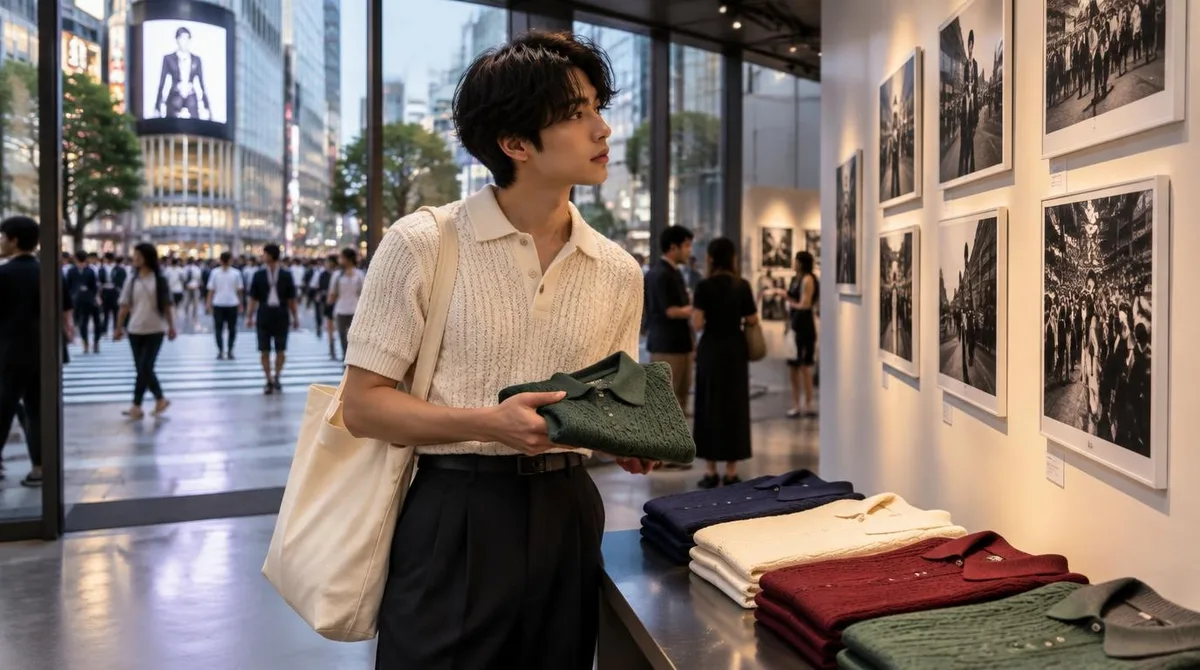
Ralph Lauren threw its first Polofest last month: a three-day festival in Shibuya, Tokyo, timed to the brand's 60th anniversary. According to Harper's Bazaar, it brought together celebrities, vintage collectors and 17 of the world's biggest Ralph Lauren sellers, plus panels with titles like The Cult of Collecting and Why Tokyo Matters. It was, the report says, the first in a year-long series of global activations.
The obvious read is that this was a fan convention, and the devotion on display was the point. The skeptical read is worth holding alongside it: a 60th anniversary is also a marketing calendar, and a festival is a very controlled way to stage fandom. Both things are true here, and the interesting part is how they overlap.
There is one detail in the reporting that a straight news write-up would skip: the panels put brand enthusiasts on stage next to cultural voices, and a mini exhibition at the entrance showed decades of photographs of Ralph Lauren himself visiting and working in Japan. That is a brand curating its own lore in real time — which is either a gift to its community or a reminder of who controls the narrative, depending on how much cynicism you brought through the door.
More on the season's mood in our fashion news coverage.
Is the Ralph Lauren fandom actually organic?
Partly, and the history is documented. Japan's love of Americana dates to the 1960s, when a Ginza-based style tribe called the Miyuki-Zoku hung around Tokyo's Miyuki-dori wearing American collegiate fashion — button-downs and tailored blazers — long before the brand arrived. When Polo Ralph Lauren did land, in 1976, opening its first Japanese store with department store Seibu, it was an immediate hit. Japanese obsessives loved the construction, the fabric aging, the patina built into American garments.
By the 1980s that had evolved into the Kir Kaji — clean casual — movement, with double-breasted blue blazers, tennis sweaters and the Polo shirt standing in for a preppy American look Japan wanted to emulate. So the Tokyo setting for Polofest is not random. The brand has decades of documented history there, and the festival leaned on it.
What about the Brooklyn side of the story?
Harper's Bazaar also traces the American fandom: the Lo-Lifes, a movement of Brooklyn kids in the 1980s and 1990s so devoted to Polo that they sometimes shoplifted pieces they could not afford — the "Lo" borrowed from "Polo." That fandom, the report notes, helped cement the brand's hype, hype that has lasted until today. It is worth sitting with the fact that one of the brand's foundational fan cultures began with theft, and that the same brand now hosts a festival celebrating its collectors. Fandom histories are rarely tidy.
What did André 3000 add to the conversation?
He attended Polofest and sat in conversation with Esquire's Michael Sebastian, and made the sharpest point of the whole event. "Ralph Lauren wasn't necessarily from the world that he ended up creating," he said, per the report. "If you are not from it, you want to make it the best." His argument: outsiders who love a culture care for it intensely, and that care is how a clothier becomes a culture. We covered a connected angle in Skin cycling wasn't invented by TikTok — here's who actually made it up.
It is a generous reading, and it fits the evidence. The brand expanded well past its preppy roots into western, streetwear, collegiate and other visions of American life, and the fandom grew with it. As the report puts it, many can be clothiers; very few create an entire community around their work.
But notice what the quote quietly concedes: the authenticity was always aspirational. Ralph Lauren built an idealized America he was not from, and Japan built an idealized version of that. Polofest is a festival about a copy of a copy that somehow became the original. That is not a knock — it is arguably the most honest thing anyone said all weekend.
Should we read Polofest as community celebration or brand strategy?
Try both at once. The collectors swapping stories and rifling through rails of archival pieces are real people with real attachments; the report describes fans building kinship and community globally. At the same time, the festival is explicitly the opening move of a year of activations marking the anniversary — an anniversary is a scheduled commercial moment, not an accident of affection. A brand that can assemble 17 top sellers, celebrity guests and curated exhibitions in Shibuya is exercising considerable control over its own mythology.
The measured take: the devotion predates the festival, so Polofest did not manufacture it. It did, however, give the brand a stage from which to narrate that devotion on its own terms, in a city where its history runs deepest. Watch what the rest of the anniversary year looks like — if the activations keep leading with collectors and community voices rather than product drops, the fan-first framing holds up. If not, we will know what the festival was really for. For more on how brands stage culture, see our piece on who actually decides when fashion week happens, and how resale's consolidation era is reshaping collecting in resale's consolidation era.