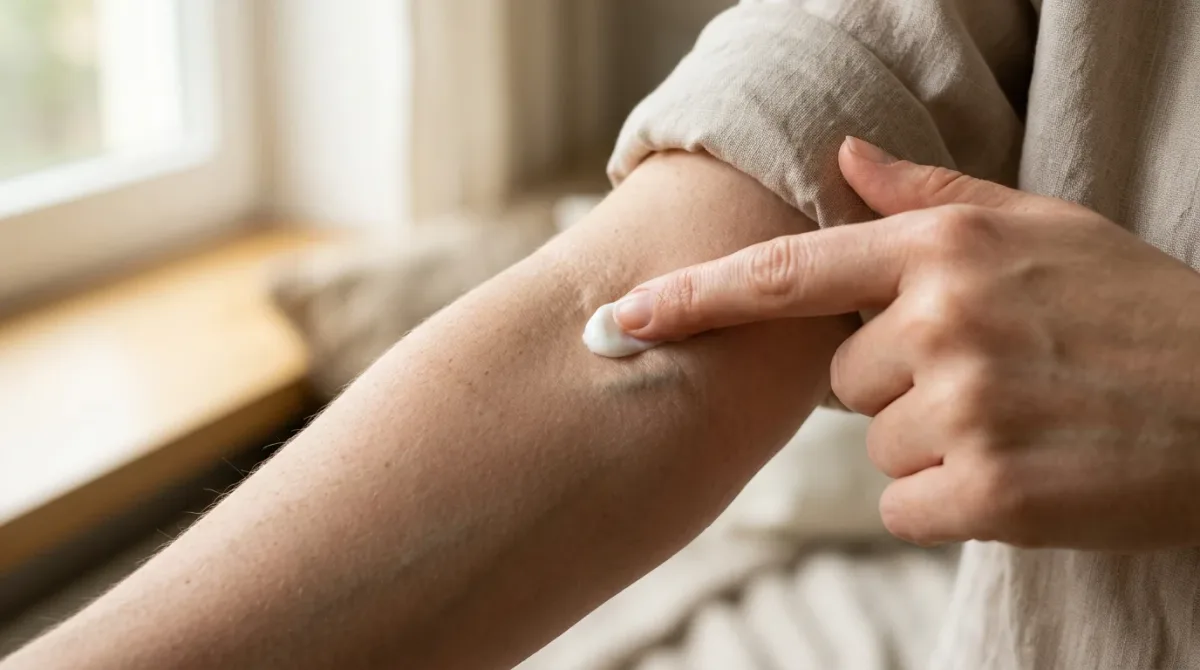
A patch test means applying a small amount of a new product to a hidden patch of skin and watching that spot for a reaction before the product ever touches your face. The American Academy of Dermatology recommends testing a quarter-sized amount twice a day for seven to 10 days on skin that won't be rubbed or washed in between, such as the inner forearm or the crease of the elbow. If nothing changes by day 10, the product is generally safe to fold into a routine.
What counts as a real patch test?
A patch test is not a five-minute sniff-and-swatch at a counter. It's a short at-home trial that mimics how the product will actually sit on skin over time, so any delayed irritation or allergic response has a chance to show up before the product reaches a more sensitive area like the face. The American Academy of Dermatology's guide to testing skin care products (AAD) describes it as applying the product to a small area, using it the way you normally would, and checking that spot daily for signs of trouble.
The point isn't to catch every possible reaction — no home test can promise that — it's to filter out the products most likely to cause obvious irritation or an allergic flare-up before they're used somewhere visible.
Where should you apply a patch test?
For most leave-on products, the AAD recommends a quarter-sized spot of skin that won't get washed or rubbed off during the test window, pointing to the underside of the arm or the bend of the elbow as reliable spots. Apply the product there in the same amount you'd normally use, and leave it on for as long as you'd normally leave it on — all day for a moisturizer, closer to five minutes for a rinse-off cleanser.
If the product is specifically meant for the face, testing on the arm is a reasonable start, but it's worth also checking a small, less visible facial area — Healthline's guide to self skin patch tests suggests a dime-sized amount behind the ear at the jawline, since facial skin can react differently than skin on the arm. The same source notes that hair products are better tested at the back of the neck, and that essential oils should never be tested directly on the face — they should be diluted first with a carrier oil, water, or lotion.
How long should the test run?
The standard timeline, per the AAD, is twice daily for seven to 10 days:
- Apply a quarter-sized amount of the product to the test spot.
- Leave it on for the length of time you'd normally use it — brief for a cleanser, longer for anything left on skin.
- Repeat this twice a day, checking the spot each time for redness, itching, or swelling.
- If seven to 10 days pass with no reaction, the product is generally fine to start using as intended.
- If a reaction shows up at any point, wash the product off right away and stop using it.
Ten days sounds long for something as ordinary as a new moisturizer, and it is tempting to shortcut it. But delayed allergic reactions in particular don't always appear on day one — that's the entire reason the window runs closer to a week and a half rather than an afternoon.
Is a quicker check ever enough?
Not every source agrees on a single timeline, and the difference is useful to understand rather than a contradiction to ignore. WebMD's guide to skin reactions from beauty products describes a shorter version: placing a small amount of product on the inside of the elbow and waiting 48 to 72 hours for a response, which is enough time to catch most immediate irritant contact dermatitis — the burning, stinging, and redness that shows up when a product simply irritates the skin barrier.
What a 48-to-72-hour check is less likely to catch is allergic contact dermatitis — a true allergy to a specific ingredient, which can take longer to develop and often involves swelling, itching, or blisters rather than just stinging. WebMD names fragrance and preservatives as the most common allergy triggers, along with alpha-hydroxy acids at concentrations above 10%, hair dyes and lighteners, and nail polish or adhesives.
| Method | Duration | Best for catching |
|---|---|---|
| Quick elbow check (WebMD) | 48 to 72 hours, single application | Immediate irritation — stinging, burning, redness |
| Full patch test (AAD) | 7 to 10 days, twice daily | Delayed reactions and true ingredient allergies |
For a product with a short, simple ingredient list, the quicker check may be a reasonable first pass. For anything with fragrance, a new active ingredient like a retinoid or an AHA, or a history of reacting to skincare, the fuller week-and-a-half version is the more cautious route.
What does a reaction actually look like?
The AAD's checklist for a failed patch test is short: redness, itching, or swelling at the test site. Healthline's guide expands that list to include discoloration, burning, stinging, a visible rash, fluid-filled blisters, hives, and skin that turns dry or tender. WebMD separates the two reaction types by cause — irritant reactions from a harsh ingredient simply overwhelming the skin barrier, and allergic reactions from the immune system responding to a specific compound, most often a fragrance or preservative.
One caveat worth knowing before starting: some active ingredients are expected to cause mild, temporary tingling or dryness in sensitive skin even when they're working as intended, according to the AAD, which specifically names retinol and glycolic acid as examples. That kind of short-lived, mild irritation isn't automatically a reason to abandon a product — it's the difference between "this stings a little at first" and "this spot is swollen and blistered" that determines whether a reaction is disqualifying.
What to do if the test spot reacts
Stop immediately. The AAD's instructions are direct: wash the product off as soon as a reaction appears, and don't use it again. A cool, damp compress or a thin layer of petroleum jelly can help calm the area afterward. WebMD adds that an over-the-counter hydrocortisone cream can also ease irritation, though a more stubborn or severe reaction may call for a prescription-strength option from a clinician. If a reaction is severe, or if it's unclear which ingredient in a product caused it, both sources point to seeing a dermatologist, who can run a professional patch test to identify the specific culprit.
Common mistakes with patch testing
Testing for less than a week. A short single check can miss a delayed allergic reaction that only shows up after several days of repeat exposure, which is exactly the gap the AAD's longer window is built to cover.
Trusting a "hypoallergenic" label as a substitute for testing. WebMD is blunt about this: marketing terms like "hypoallergenic" carry no regulatory guarantee and shouldn't replace an actual patch test.
Testing fragrance directly on skin. WebMD's advice for fragrance products specifically is to apply them to clothing rather than skin, since fragrance is one of the most common triggers for allergic reactions.
Ignoring mild irritation from actives without context. A small amount of tingling from a retinoid or glycolic acid, per the AAD, can be a normal, temporary adjustment rather than a reaction — the distinction matters when deciding whether to stop or continue at a lower frequency.
Do you need to patch test everything?
Practically, patch testing every single product — from a basic rinse-off cleanser to a fragrance-free moisturizer already used for years — isn't necessary for most people. The precaution matters most for new active ingredients, anything with added fragrance, and any product going onto skin that's already irritated, sensitive, or reactive to past products. Sensitive or reactive skin, and skin with a compromised barrier, is exactly the case where a patch test is worth the extra week.
For a related skincare perspective, read How to patch test a new skincare product.
For more context, read Decoding the Latest Gen Z Beauty Trends: What You Need to Know.
For more context, read hand.
For more context, read makeup.